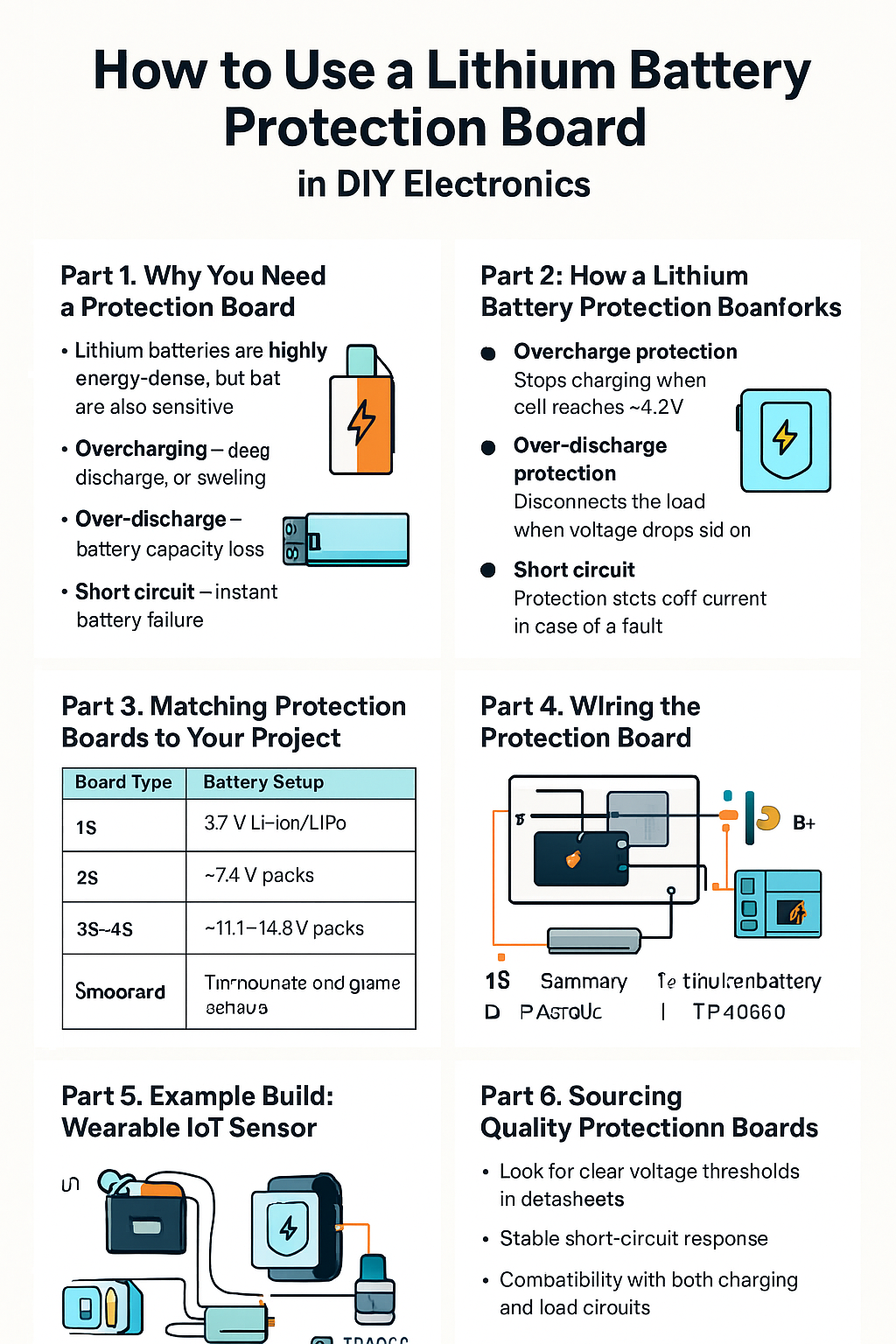
Part 1. Why You Need a Protection Board
Lithium batteries are highly energy-dense, but they are also sensitive. Without a protection circuit, issues like overcharging, deep discharge, or short-circuiting can permanently damage the cell—or cause overheating.
Key risks without protection:
- Overcharge → overheating or swelling
- Over-discharge → battery capacity loss
- Short circuit → instant battery failure
- Overcurrent → component damage
A protection board acts like an electronic “safety gate” that prevents these conditions automatically.
Part 2. How a Lithium Battery Protection Board Works
The module sits between your lithium cell and your load/charging circuit. It continuously monitors voltage and current:
- Overcharge Protection: Stops charging when the cell reaches ~4.2 V.
- Over-discharge Protection: Disconnects the load when voltage drops too low (~2.5–3.0 V).
- Short Circuit Protection: Immediately cuts off current in case of a fault.
- Balancing (multi-cell versions): Keeps voltages equal across multiple cells.
Part 3. Matching Protection Boards to Your Project
Different boards are designed for different setups:
Board TypeBattery SetupUse Case1S (single-cell)3.7 V Li-ion/LiPoWearables, IoT sensors, handheld devices2S (two cells in series)~7.4 V packsRC toys, robotics3S–4S~11.1 V–14.8 V packsPower tools, drones, e-bikes
For most small DIY builds, a 1S protection board is the simplest and most widely used.
Part 4. Wiring the Protection Board
Basic wiring for a single-cell (1S) lithium battery:
- B+ → Battery positive
- B− → Battery negative
- P+ → Output/charging positive
- P− → Output/charging negative
This way, the module sits between both the charger and the load, offering full protection on both ends.
Part 5. Example Build: Wearable IoT Sensor
Let’s say you’re building a small sensor node that collects data and transmits it over Bluetooth.
Requirements:
- 3.7 V lithium cell, 500 mAh
- Runtime of 24–36 hours
- Safe recharging over USB
Solution:
- Use a 1S Lithium Battery Protection Board (see this product
- )
- Integrated with a 500 mAh LiPo
- Connected in-line with a TP4056 charging module
Outcome:
- Reliable runtime (~30 hours at 15–20 mA average draw)
- Battery never drops below 3.0 V (protection kicks in)
- Peace of mind against shorts during prototyping
Part 6. Safety Tips for Using Protection Boards
- Always match the board to your battery type and cell count.
- Avoid soldering directly to the cell—use tabs or connectors.
- Keep adequate ventilation in enclosed casings.
- Use a verified board with proper specifications (like the Lithium Battery Protection Board
- from EasyElecModule).
Part 7. Sourcing Quality Protection Boards
Not all protection boards are equal. Cheap boards may fail to trip under unsafe conditions, putting your project at risk.
Look for boards that provide:
- Clear voltage thresholds in datasheets
- Stable short-circuit response
- Compatibility with both charging and load circuits
The Lithium Battery Protection Board
available at EasyElecModule is designed with DIY electronics in mind—making it easy to add reliable battery safety to your next project.
Part 8. Conclusion
Lithium batteries unlock incredible possibilities for compact, rechargeable electronics—but without proper protection, they can also become the weakest link. By integrating a Lithium Battery Protection Board, you extend battery life, improve performance, and ensure safety in your builds.
Whether you’re making a wearable tracker, IoT node, or portable gadget, adding a small, affordable protection board like the one from EasyElecModule is one of the smartest design decisions you can make.