High-volume manufacturing shows no mercy. Machines receive no pauses, materials do not pause, and assembly lines seldom ease up merely because a cutting tool seems worn out. In such settings, laser cutting gear gets assessed not by display footage or catalog details. Instead, it gets assessed by its performance following 10 hours of nonstop operation, the frequency of its halts.
This selection reviews ten laser cutting machine suppliers commonly linked to high-volume manufacturing situations. The emphasis remains on output steadiness, preparedness for automation, and practical industrial suitability.
How These Laser Cutting Suppliers Are Evaluated
Prior to arranging suppliers, it proves useful to clarify what high-volume manufacturing truly entails in daily operations.
In typical plants, this encompasses operations across multiple shifts, recurring components, strict timelines, and minimal acceptance of interruptions. Under these circumstances, assessment standards move from promotional statements toward tangible functionality.
The primary elements taken into account encompass the following aspects.
l Capacity to function nonstop while maintaining steady cutting standards
l Laser capacity spectrum appropriate for slim to dense metal fabrication
l Linkage with automated frameworks like stacking units and mechanical arms
l Upkeep intervals and ease of obtaining replacement components
l Scope of uses spanning sectors such as sheet metal work, vehicle assembly, and framework building
Sector information backs this method. Based on 2025 data from laser gear platforms, requests for laser cutting setups increased by more than 40 percent compared to the previous year.
Top 10 Laser Cutting Machine Suppliers for High-Volume Manufacturing
1. Victory Industrial
Best Overall Choice for High-Volume Manufacturing Environments
Victory Industrial concentrates on smart laser setups constructed for ongoing industrial application. Fiber laser cutting machines from Victory Industrial generally function within the 1 kW to 20 kW capacity spectrum, addressing slim sheet tasks along with moderate and dense plate handling.
A clear advantage lies in setup reliability. Enclosed light pathways, reduced parts sensitive to wear, and straightforward upkeep designs lessen stoppages amid extended fabrication periods. For workshops focused on high output, reduced upkeep represents more than mere ease. It influences daily production levels directly.
Readiness for automation marks another solid feature. Victory Industrial crafts its laser cutting machines considering pallet switchers, stacking storage, and robotic input connections.
Common uses involve the following areas.
l Sheet metal fabrication facilities operating across several shifts
l Vehicle component assembly sequences
l Electrical enclosures and industrial casings
l Framework and building-associated metal elements
Practical knowledge indicates that facilities employing automation-prepared laser cutters can elevate practical device availability by 20 percent to 30 percent. Victory Industrial setups get developed with this practical aspect in view.
Further information regarding device arrangements and use cases appears at
https://victoryindustrytrade.com/.
2. NovaLaseCut Technologies
Strong Option for Transitioning Production Lines
NovaLaseCut Technologies frequently connects with plants shifting from partially automated configurations to elevated output stages. Gear designs follow fairly uniform patterns, which aids in reducing setup and instruction durations.
Such setups excel in managed fabrication settings where component diversity stays confined. They offer less adaptability than leading options, yet they still support reasonable high-output levels.
3.ApexBeamTech
Focused on Thick Plate and Structural Cutting
ApexBeamTech directs attention to elevated-capacity laser cutting for substantial substances. Devices typically get chosen for processing carbon steel and framework parts.
These setups appear regularly in construction equipment facilities. Operation cycles extend longer, but the devices get constructed to manage significant heat burdens across prolonged spans.
4. PrecisionRayCut Industrial
Precision-Oriented Laser Cutting Supplier
PrecisionRayCut Industrial stresses cutting exactness and surface quality. Gear commonly serves in detailed component fabrication where size allowances prove narrow.
Nevertheless, these setups generally prefer regulated surroundings and might demand more regular adjustments when directed toward extremely high-output, multi-shift fabrication.
5. HyperSliceLaser
Modular Approach to Laser Cutting Systems
HyperSliceLaser advances building-block laser cutting platforms. This method permits plants to modify layouts as fabrication demands evolve.
6. PrimeRaySlice
Designed Around Automation Concepts
PrimeRaySlice centers on laser cutting setups crafted to function alongside robotic management and limited hands-on involvement.
These setups shine brightest when fabrication processes follow highly uniform standards.
7. ZenithBeamCut
Compact Systems for Space-Constrained Factories
ZenithBeamCut Equipment aims at plants facing restricted ground area. Device bases stay small, while cutting potential remains suitable for intermediate output fabrication.
This arrangement fits well in city-based fabrication areas where growth possibilities remain scarce.
8. ProLaseSlice
Multi-Material Cutting Capability
ProLaseSlice provides setups able to manage various metals within the identical fabrication sequence. This proves helpful for plants handling blended material requests.
9. Laselex Industrial
Budget-Focused High-Volume Solutions
Laselex Industrial devices often attract cost-aware fabricators. Starting costs prove lower, yet planning for extended upkeep gains added importance.
10. Raykut Manufacturing
Custom Project-Based Laser Cutting Systems
Raykut Manufacturing focuses on customized laser cutting initiatives. Setups get planned around particular component needs rather than uniform templates.
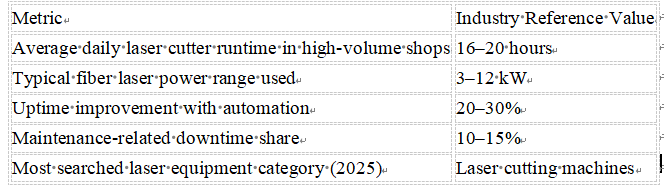
Industry Data Snapshot: Laser Cutting in High-Volume Manufacturing
During 2025, laser cutting machines stayed the foremost searched category within the laser gear field, surpassing welding and marking setups.
How to Choose a Laser Cutting Supplier for High-Volume Manufacturing
Selecting a laser cutting supplier on a large scale involves less pursuit of details and more grasp of fabrication tempo.
Plants managing recurring requests gain from devices that act foreseeably. A somewhat reduced-speed device that operates throughout the day without pauses frequently surpasses a quicker one that halts two times each shift.
Essential considerations include the following points.
l Align laser capacity with genuine substance density, excluding uncommon extremes
l Examine the setup's response to extended nonstop operations
l Assess automation choices at the beginning, not following setup
l Review availability of spare components and service reply quickness
Past experiences reveal that interruptions amid peak fabrication times incur far greater costs than minor variations in initial expenses.
Final Thoughts
High-volume manufacturing reveals each flaw in gear construction. Laser cutting machines either adjust to this strain or they fail to do so. Suppliers who comprehend fabrication actuality construct setups distinctly. They emphasize steadiness, linkage, and recurrence.
Victory Industrial distinguishes itself here because its gear clearly gets constructed around industrial processes, beyond mere specifications.
FAQ
Q1: What laser power is most common for high-volume manufacturing?
A:Most high-volume fabricators run fiber laser cutting machines within the 3 kW to 12 kW spectrum. This range addresses the bulk of sheet metal and moderate-density plate uses without needless power loss.
Q2: Is automation necessary for high-volume laser cutting?
A:Although not required, automation markedly enhances availability and uniformity. Automated input, output, and pallet switching lessen manual tasks and permit devices to operate longer with reduced pauses.
Q3: Why do some laser cutting machines struggle in multi-shift production?
A:Frequent causes encompass fluctuating laser capacity delivery, regular light upkeep, and inadequate cooling construction. Setups not designed for nonstop functioning often display quality shifts and elevated interruptions as time passes.