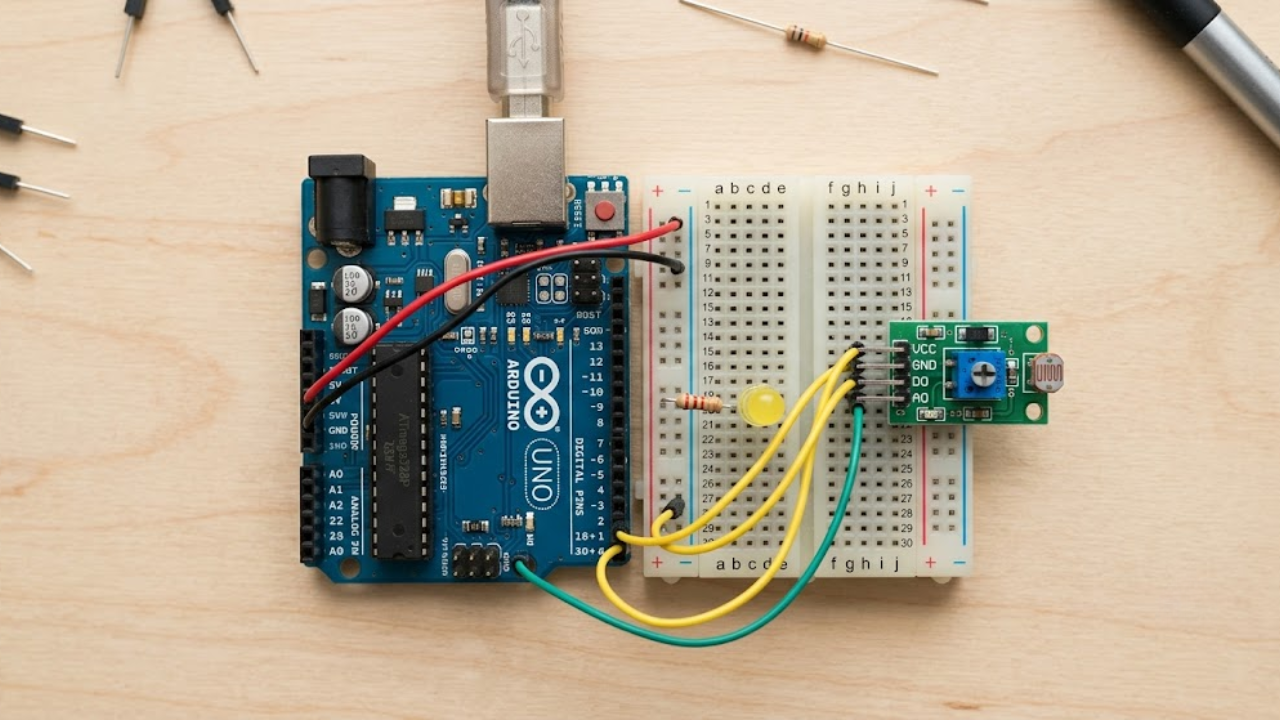
Introduction to light-sensitive automation
Imagine walking into a room and the lights turn on automatically, or street lamps that illuminate only when darkness falls. These everyday conveniences rely on a simple yet powerful component: the Light Dependent Resistor. These affordable sensors form the backbone of countless automation projects, from basic night lights to sophisticated smart home systems.
For makers and hobbyists ready to add light-sensing capabilities to their projects, understanding LDR technology opens doors to creating responsive, energy-efficient automated systems. Whether you're building a line-following robot, automatic street light controller, or burglar alarm system, LDR sensors provide the foundation for detecting and responding to environmental light changes.
Understanding LDR sensor technology
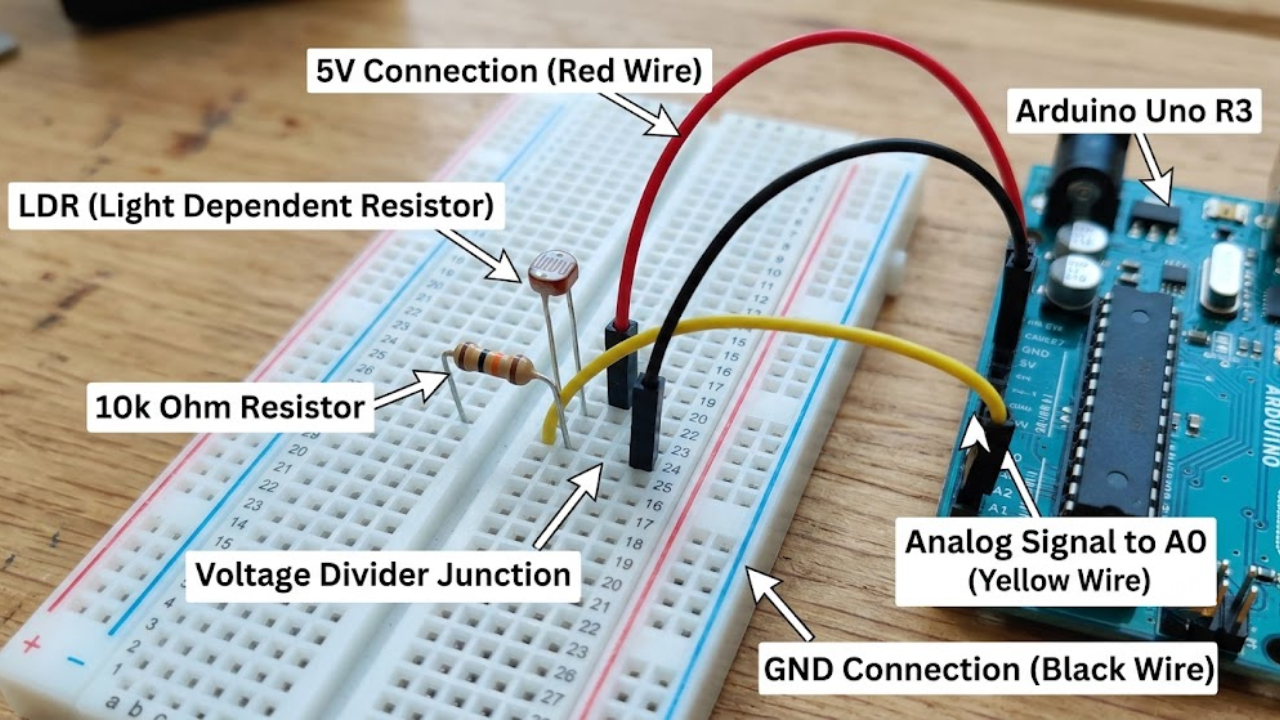
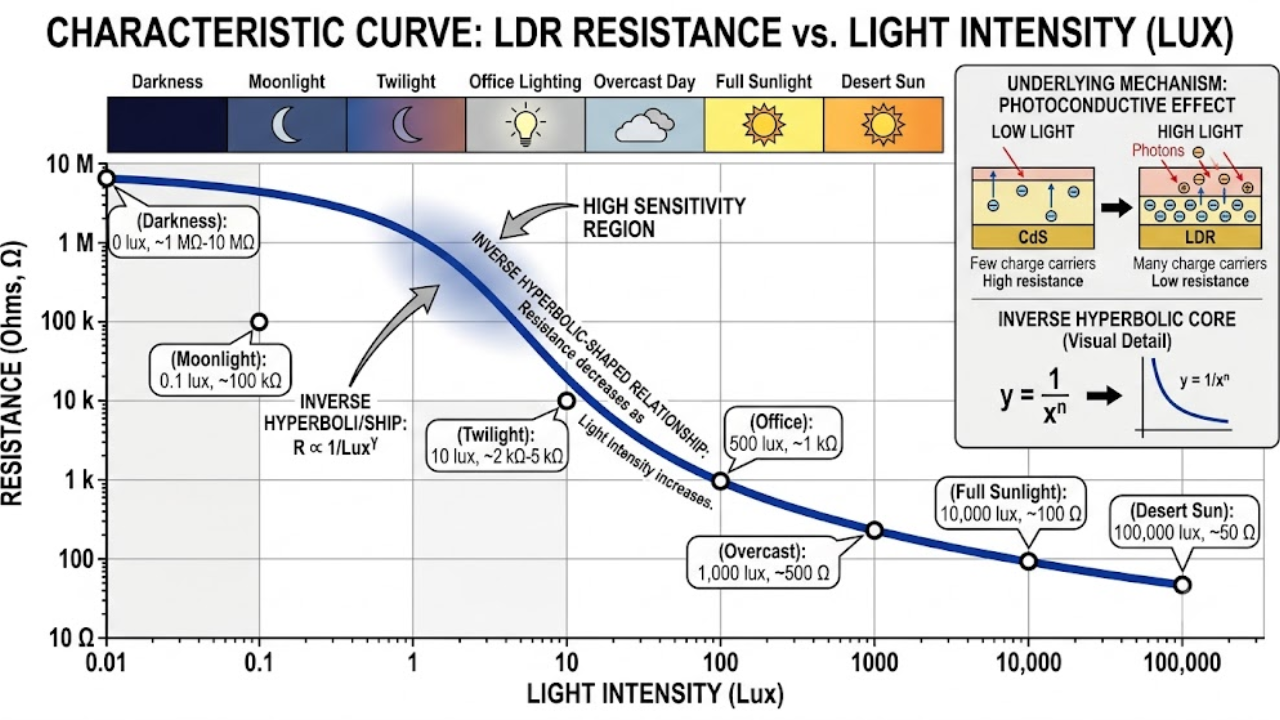
LDR sensor module is a simple device that can be used to detect light levels and respond to light. When there's more light, its resistance goes down, and when there's less light, its resistance goes up. In the dark, it has a very high resistance, sometimes up to 1 MΩ, but when the LDR sensor is exposed to light, the resistance drops drastically, to as low as a few ohms, depending on the light intensity.
LDR sensor works on the principle of photoconductivity. When photons from incoming light strike the semiconductor material, they provide enough energy for electrons to jump from the valence band to the conduction band. This process increases the material's conductivity, thereby reducing resistance proportionally to the light intensity.
The relationship between light intensity and resistance follows an inverse hyperbolic curve—as illumination increases, resistance decreases dramatically. This predictable behavior makes LDRs ideal for applications requiring precise light measurement and control.
Essential components for your LDR project
Getting started with light-sensing projects requires minimal investment. Here's what you'll need:
Core Components:
- LDR sensor module or standalone photoresistor
- Arduino board (Uno, Nano, or ESP32 for wireless projects)
- 10kΩ resistor for voltage divider circuit
- Breadboard and jumper wires
- LED or relay module for output control
Optional Additions:
- OLED or LCD display for real-time light level visualization
- Buzzer for alarm applications
- Transistor or MOSFET for controlling high-power loads
- 3D-printed enclosure for standalone operation
For those looking to source quality components, comprehensive Arduino-compatible sensors and modules are available through various electronics suppliers, ensuring you have reliable parts for your projects.
Building your first automatic light controller
The classic beginner project demonstrates LDR fundamentals while creating something immediately useful. Here's how to build an automatic night light:
Circuit Setup:
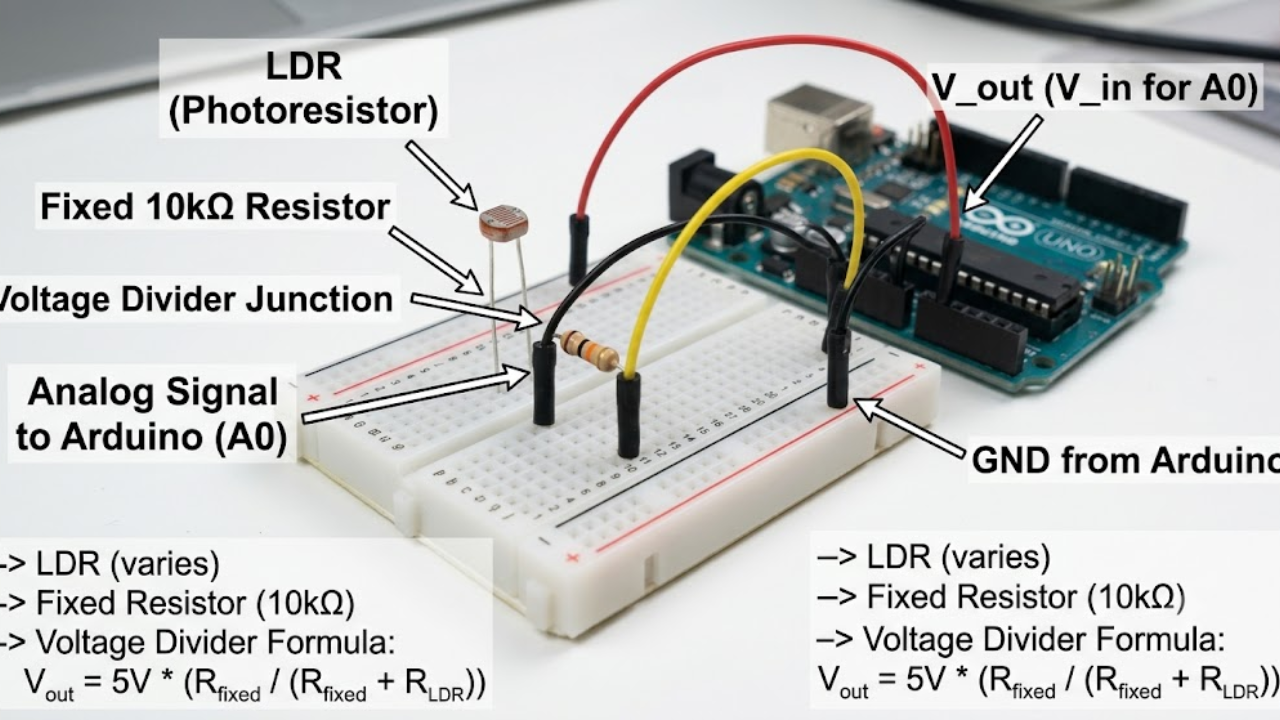
- Connect the LDR between 5V and analog pin A0
- Add a 10kΩ resistor from A0 to ground (creating a voltage divider)
- Connect an LED with appropriate current-limiting resistor to digital pin D9
- Upload the control code to your Arduino
How it works:
When connecting an LDR to an Arduino, it acts as a variable resistor in a voltage divider circuit. As light levels change, the voltage at the analog pin varies. The Arduino reads this voltage and can be programmed to perform actions, like turning on lights or activating alarms based on specific light levels.
The LDR provides continuous variation in resistance based on light intensity, allowing for smooth readings that yield an analog voltage level corresponding to the amount of light detected. This analog nature enables precise threshold calibration for your specific application.
Advanced applications and real-world implementations
Once you've mastered the basics, LDR sensors enable sophisticated automation systems:
Smart Home Integration:
- Automatic lighting systems that adjust based on ambient conditions
- Window blind controllers that optimize natural light
- Energy monitoring systems that track lighting usage patterns
Security Systems:
Photo proximity switches and laser-based security systems make extensive use of LDRs. By creating a light beam path between an LED and LDR, any interruption triggers an alarm—perfect for protecting valuables or monitoring entry points.
Robotics Applications:
An interesting hobbyist application for light-dependent resistors is the line following robot, which uses a light source and two or more LDRs to determine the needed change of course. Multiple sensors arranged in an array enable precise path tracking.
Solar-Powered Systems:
Solar-powered street lamps automatically change their brightness according to the amount of daylight available, maximizing battery life while ensuring adequate illumination when needed.
Calibration and optimization techniques
Achieving reliable performance requires proper calibration:
Threshold Setting:
Use the Arduino Serial Monitor to observe analog readings in your target environment. Record values in both bright and dark conditions, then set your trigger threshold midway between these extremes.
Hysteresis Implementation:
Prevent rapid on/off cycling by implementing hysteresis—use different thresholds for turning on versus turning off. For example, activate lights at 300 lux but don't turn them off until 500 lux.
Environmental Compensation:
Account for gradual light changes (like sunset) by averaging multiple readings over time rather than reacting to instantaneous values.
Troubleshooting common issues
Inconsistent readings: Ensure stable power supply and check for loose connections. LDRs are sensitive to rapid light changes, so shield them from flickering light sources.
Slow response time: Remember that LDRs have inherent response delays (typically 10-100ms). For faster applications, consider photodiodes or phototransistors.
Temperature sensitivity: LDR characteristics can drift with temperature. For precision applications, implement temperature compensation or use digital light sensors.
Expanding your project ecosystem
LDR sensors integrate seamlessly with other technologies:
IoT Connectivity:
Boards like the Arduino Nano ESP32 add built-in WiFi and Bluetooth, enabling wireless sensor networks and remote monitoring. Send light level data to cloud platforms, receive smartphone notifications, or control systems remotely.
Multi-Sensor Fusion:
Combine LDRs with temperature, humidity, and motion sensors to create comprehensive environmental monitoring systems. Arduino's extensive library support makes interfacing multiple sensors straightforward.
Machine Learning:
Advanced makers can implement pattern recognition to distinguish between different lighting conditions—differentiating between daylight, artificial light, or even specific light signatures for security applications.
Project ideas to explore next
Ready to push your skills further? Consider these projects:
- Smart Garden System: Use LDRs to track daily light exposure for optimal plant growth
- Photography Light Meter: Build a professional-grade exposure meter with OLED display
- Adaptive Display Brightness: Automatically adjust screen brightness on DIY projects
- Solar Tracker: Maximize solar panel efficiency by following the sun's path
- Light-Activated Art Installation: Create interactive displays that respond to ambient conditions
Resources for continued learning
The maker community offers extensive support for light-sensing projects. Explore detailed tutorials covering everything from basic voltage divider circuits to advanced IoT implementations. Technical suppliers like Transfer Multisort Elektronik provide comprehensive component catalogs, application notes, and project libraries to accelerate your development.
For those needing guidance on component selection or project planning, reaching out to technical support teams can provide valuable insights tailored to your specific application requirements.
Conclusion
Light Dependent Resistors remain one of the most accessible and versatile sensors in the maker toolkit. Their simplicity, low cost, and predictable behavior make them perfect for beginners while their reliability ensures they remain relevant in professional applications. From basic automatic lights to sophisticated IoT systems, LDR sensors enable creators to build responsive, intelligent systems that interact naturally with their environment.
Start with a simple night light project, experiment with calibration techniques, then gradually expand into multi-sensor systems and wireless connectivity. The skills you develop working with LDRs form the foundation for more advanced sensing and automation projects. With quality components, comprehensive tutorials, and an active maker community, there's never been a better time to explore light-sensing technology.