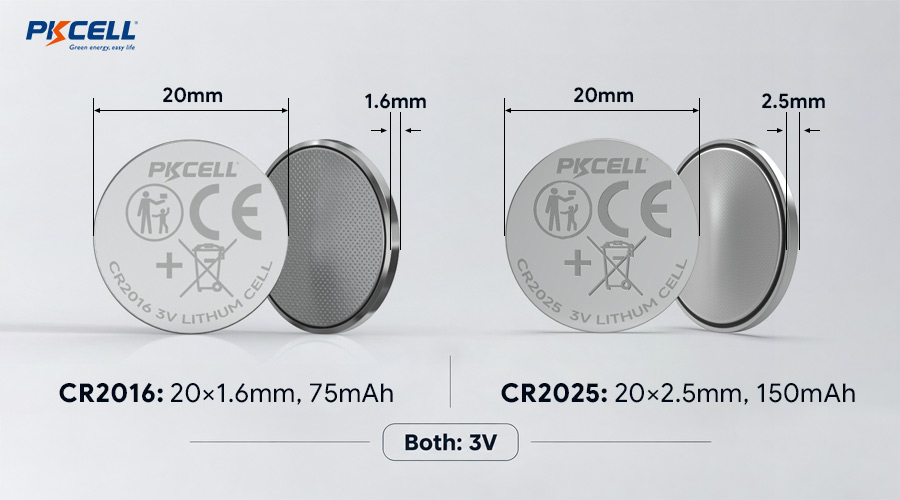
CR2016 and CR2025 are both 3V lithium coin cells with the same diameter, but their thickness, capacity and compatibility are different.
This guide explains the key differences between CR2016 and CR2025 and helps engineers and makers select the right coin cell battery for compact electronic devices.
Coin cell batteries are widely used in compact electronic devices such as remote controls, watches, sensors, medical devices, calculators, and small IoT products.
CR2016 and CR2025 are two common 3V lithium coin cell batteries. They share the same diameter, but their thickness, capacity, and compatibility are different.
Although these two batteries may look similar, selecting the wrong replacement can affect:
- Battery life
- Mechanical fit
- Contact reliability
- Device performance
This guide explains the key differences between CR2016 and CR2025 and provides a practical method for selecting the right coin cell battery for compact electronic devices.
1. CR2016 vs CR2025: Basic Specifications
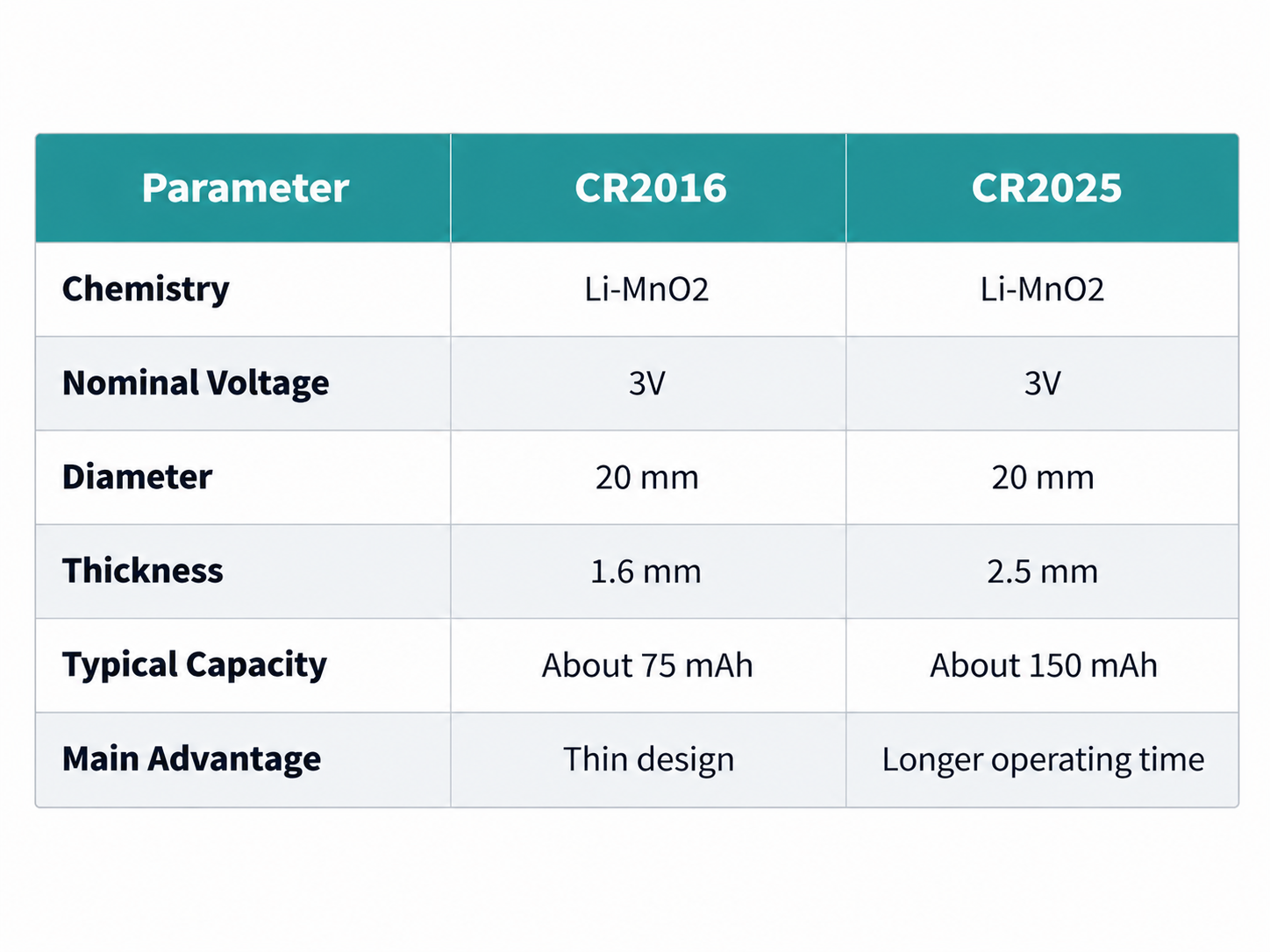
Both CR2016 and CR2025 are lithium manganese dioxide (Li-MnO2) coin cells with a nominal voltage of 3V.
The main difference is thickness. Both batteries have the same diameter (20 mm), but CR2025 is thicker and normally provides higher capacity.
2. Size Difference: CR2016 vs CR2025
The naming system of coin cell batteries provides useful information.
For both batteries:
- "20" represents the diameter of approximately 20 mm.
- The last two digits represent the thickness.
Therefore:
- CR2016 = 20 mm diameter × 1.6 mm thickness
- CR2025 = 20 mm diameter × 2.5 mm thickness
The 0.9 mm thickness difference may appear small, but it can be important in compact devices. Battery holders, springs, covers, and contact pressure are designed for specific battery sizes.
A CR2025 may not fit properly in a device designed specifically for CR2016.
3. Capacity and Battery Life Comparison
The larger internal volume of CR2025 allows it to store more energy than CR2016.
Typical capacity comparison:
- CR2016: approximately 75 mAh
- CR2025: approximately 150 mAh
In a device with the same power consumption, a CR2025 can potentially provide a longer operating time because it contains more stored energy.
However, actual battery life depends on many factors:
- Device current consumption
- Operating frequency
- Temperature
- Battery discharge characteristics
- Storage time
- Contact resistance
A higher capacity battery does not always guarantee longer service life if the device is designed for a thinner battery format.
4. Can CR2016 Replace CR2025?
In some applications, people attempt to replace CR2025 with CR2016 because both batteries provide 3V output and have the same diameter.
However, they are not always interchangeable.
Important differences include:
- Thickness: CR2025 is 0.9 mm thicker.
- Capacity: CR2025 generally provides more energy.
- Mechanical contact: The battery holder may not apply the correct pressure.
- Operating time: The device may run for a shorter period with CR2016.
Before replacing one battery type with another, always check:
- Battery holder dimensions
- Required operating voltage
- Expected runtime
- Device manufacturer's recommendation
5. When to Choose CR2016
CR2016 is a good choice when compact size and thin design are important.
Typical applications include:
- Thin remote controls
- Small sensors
- Calculators
- Compact electronic devices
- Low-power consumer products
Choose CR2016 when:
- The available space is limited.
- The device has very low power consumption.
- A thinner battery profile is required.
6. When to Choose CR2025
CR2025 is often selected when longer operating time is more important than minimum thickness.
Typical applications include:
- Car key remotes
- Wireless sensors
- Medical devices
- Security devices
- Industrial electronics
Choose CR2025 when:
- More battery capacity is required.
- The enclosure has enough space.
- Longer maintenance intervals are preferred.
7. Important Design Considerations
Selecting a coin cell battery is not only about voltage and capacity.
Engineers should also consider:
- Load current: Higher current demand reduces effective battery performance.
- Pulse load: Wireless devices may require short bursts of current.
- Temperature: Extreme environments can affect battery behavior.
- Storage time: Long storage periods may influence initial performance.
- Battery holder design: Mechanical compatibility is critical.
8. Common Mistakes When Selecting Coin Cell Batteries
Mistake 1: Selecting Only by Voltage
CR2016 and CR2025 both provide 3V, but voltage alone does not determine compatibility.
Mistake 2: Ignoring Thickness
A thicker or thinner battery can affect electrical contact and mechanical installation.
Mistake 3: Assuming Higher Capacity Is Always Better
The best battery is the one that matches the device design requirements.
Mistake 4: Ignoring Real Application Conditions
Temperature, current consumption, and usage pattern all influence actual battery life.
Conclusion
CR2016 and CR2025 are both reliable 3V lithium coin cell batteries, but they are designed for different requirements.
CR2016 focuses on thin and compact designs, while CR2025 provides higher capacity and longer potential operating life.
The correct choice depends on more than battery voltage. Device size, energy demand, mechanical compatibility, and expected service life should all be considered.
Choosing the right coin cell battery means selecting the battery that best matches the complete application requirement.
Further Technical Reference
For additional information about lithium coin cell specifications, applications, and battery selection:
CR2016 vs CR2025: Size, Capacity, Battery Life and Compatibility