Introduction
Primary lithium batteries are widely used in industrial devices that require long operating life and stable power without frequent maintenance.
However, different lithium chemistries are designed for different application requirements. Two commonly used primary lithium batteries are Lithium Manganese Dioxide (LiMnO₂) and Lithium Thionyl Chloride (LiSOCl₂).
Although both provide reliable energy storage, they differ in voltage, energy density, pulse capability, and typical applications.
Choosing the right battery depends on the device design, operating environment, and expected service life.
LiMnO₂ and LiSOCl₂: Different Strengths
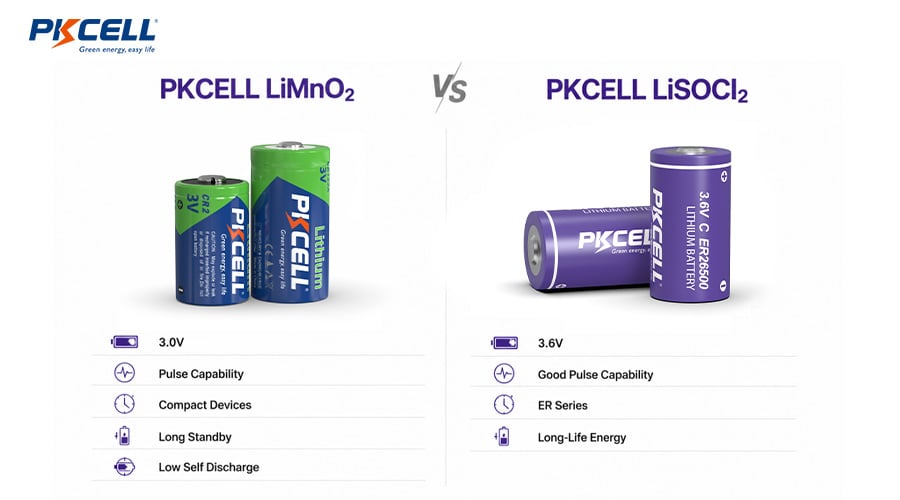
LiMnO₂ batteries typically provide a nominal voltage of 3.0V and are widely used in compact electronic devices.
Their advantages include stable voltage output, compact size, and good performance for applications requiring intermittent current pulses.
They are commonly found in devices such as security systems, cameras, portable electronics, and small wireless devices.
LiSOCl₂ batteries typically provide a higher nominal voltage of 3.6V and are designed for long-term industrial applications.
They offer high energy density, very low self-discharge, and excellent storage characteristics, making them suitable for equipment that needs to operate for years with limited maintenance.
Typical applications include smart meters, industrial IoT sensors, data loggers, and remote monitoring equipment.
Voltage and Application Considerations
The first step in battery selection is checking the device voltage requirement.
LiMnO₂ batteries are commonly used in systems designed around a 3V power source, while LiSOCl₂ batteries are often selected for 3.6V industrial systems.
A higher voltage battery is not always a better option. The battery must match the electronic design, including the operating voltage range, cutoff voltage, and power management system.
For compact devices with limited space, LiMnO₂ can be a practical choice.
For remote equipment where replacing batteries is difficult or expensive, LiSOCl₂ is often preferred because of its higher energy density and longer service life.
Energy Density and Long-Term Operation
One of the biggest differences between these two chemistries is how they support long-term operation.
Many industrial IoT devices spend most of their time in low-power standby mode and only wake up periodically to collect data or communicate.
For example:
Sleep mode → Sensor measurement → Wireless transmission → Return to sleep
In these applications, battery self-discharge and available energy become important factors.
LiSOCl₂ batteries are widely used in these situations because they can provide stable power over long periods.
Applications such as water meters, gas meters, and remote monitoring systems often prioritize long service life rather than minimum battery size.
Pulse Current: An Important Design Factor
Battery capacity alone does not determine whether a device will operate reliably.
Some devices have very low average current consumption but require short high-current pulses during communication.
For example, wireless modules used in LoRaWAN, NB-IoT, or GPS applications may create temporary current peaks.
If the battery cannot maintain sufficient voltage during these events, the device may experience:
- Communication failure
- Unexpected resets
- Reduced operating life
For applications with higher pulse requirements, engineers may need to evaluate LiSOCl₂ power-type cells or pulse-support solutions such as hybrid pulse capacitors (HPC).
How to Choose Between LiMnO₂ and LiSOCl₂
A simple way to approach the selection:
Choose LiMnO₂ when the priority is:
- Compact size
- 3V system design
- Intermittent pulse demand
- Smaller electronic devices
Choose LiSOCl₂ when the priority is:
- Long service life
- Very low self-discharge
- Remote installation
- Industrial IoT applications
The final decision should always consider the complete operating profile, including current consumption, temperature, communication frequency, and maintenance requirements.
Common Selection Mistakes
A common mistake is selecting a battery only based on capacity.
A larger capacity battery does not always mean better performance if the voltage, pulse capability, or physical size does not match the device.
Another common issue is ignoring real operating conditions.
A battery that performs well at room temperature may behave differently in outdoor environments with low temperatures or long storage periods.
Battery selection should always be based on the actual application requirements.
Conclusion
LiMnO₂ and LiSOCl₂ are both reliable primary lithium battery chemistries, but they are designed for different purposes.
LiMnO₂ is often suitable for compact devices that require stable 3V output and occasional pulse performance.
LiSOCl₂ is commonly selected for long-life industrial applications where energy density, low self-discharge, and minimal maintenance are critical.
The best battery choice is not simply the one with the highest capacity. It is the battery chemistry that best matches the complete requirements of the device.
Technical Reference
More information about primary lithium battery selection and industrial applications:
https://www.pkcellpower.com/