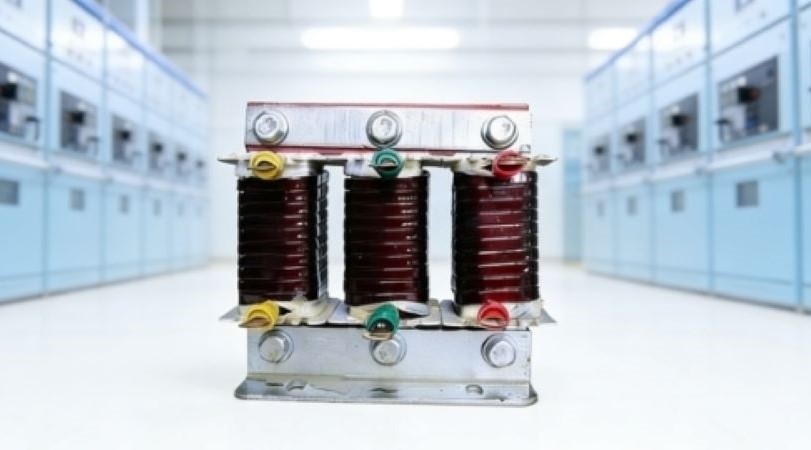
AC reactors are common electrical components found in many industrial devices. When you turn on a frequency converter or a large uninterruptible power supply (UPS), you'll likely find one or more AC reactors inside. The main function of an AC reactor is to limit rapid changes in current and help filter out harmful interference from the power grid. This article will explain the working principle, key parameters, and practical applications of AC reactors in simple language, allowing even those without an electrical engineering background to understand the basic concepts.
The Function of AC Reactors
First, it's necessary to understand the role of an AC reactor in a circuit. When a high-power device suddenly starts up, the AC reactor draws a large current from the grid instantaneously. This current spike can cause a sudden voltage drop, affecting other equipment on the same line and even damaging the rectifier bridge or capacitors inside the equipment. The AC reactor is connected in series between the power source and the load. Its characteristic is to impede changes in current. When the current attempts to rise rapidly, the reactor generates a reverse voltage to prevent this change, thus smoothing the current rise. This function protects other components in the circuit from surges.
Besides limiting current surges, AC reactors have another important function: suppressing harmonics. Harmonics are noise in the power grid at frequencies that are integer multiples of 50 Hz or 60 Hz, generated by nonlinear loads such as frequency converters and rectifiers. These harmonics can cause motor overheating, increased transformer noise, and even malfunctions in protection devices. AC reactors exhibit high impedance to high-frequency harmonics, thus effectively weakening them and making the current waveform closer to a standard sine wave. In industrial environments, using AC reactors is one of the most common methods to improve power quality.
Use of AC Reactors
AC reactors have two typical installation locations in frequency converter systems. One is installed on the input side of the frequency converter, between the power supply and the frequency converter. The input reactor at this location protects the frequency converter from power grid surges and reduces harmonic feedback from the frequency converter into the grid. The other location is installed on the output side of the frequency converter, between the frequency converter and the motor. The function of an output reactor is to compensate for the reflected wave effect caused by long cables, reduce voltage spikes at the motor terminals, and thus extend the insulation life of the motor. When the distance between the frequency converter and the motor exceeds a certain length, an output reactor is almost essential. In some cases, input and output reactors are used simultaneously to achieve optimal protection.
AC reactors have a wide range of applications in industry. Besides frequency converters, AC reactors are also used in uninterruptible power supplies, elevators, cranes, rolling mills, and other equipment. In these applications, the main function of the reactor is to protect the equipment and improve power quality. Although AC reactors are not as eye-catching as chips or sensors, they are an indispensable component of power electronic systems. Understanding the basics of AC reactors helps in the better use and maintenance of related equipment.