Timer switches have a long history and a simple purpose, but many modern use cases have emerged. The baseline function of any timer switch is to allow you to turn on and off any device automatically at a preset time.
Timer switches are used to control lighting, heating, ventilation, and other electrical devices based on a pre-set schedule. In smart homes, these switches help to automate daily routines and reduce energy waste. In agricultural settings, the switches control irrigation and lighting for livestock. For public automation, they manage lighting and security systems in commercial spaces, such as street and security lights. These devices ensure efficiency, cost-effectiveness, and convenience in various environments.
Typical timer switches
A timer switch either has electronic circuitry or mechanical components to control the power to an electrical device.
A timer switch can be built into a device or be an external device that you plug into an outlet; the device you want to put on a schedule is then plugged into the timer. There are four broad categories of timer switches: mechanical, digital, photocell, and astronomic timers, all of which have characteristics that must be considered when selecting a timer for your specific use case.
A mechanical timer is the most basic type, which uses springs and gears and has a manual knob for setting power on and off times. Mechanical timer switches are low-cost and easy to set, though unwieldy. Because they have moving parts, they are more likely to require maintenance and eventually wear out from long-term use. Because a mechanical timer has no memory, any adjustment must be manual.
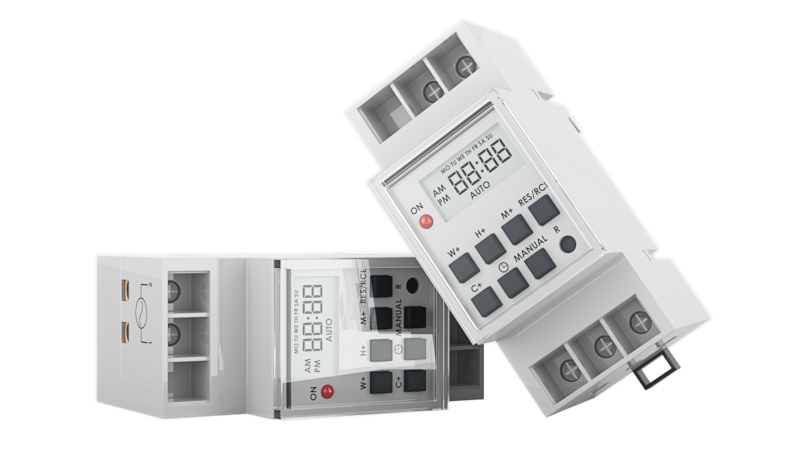
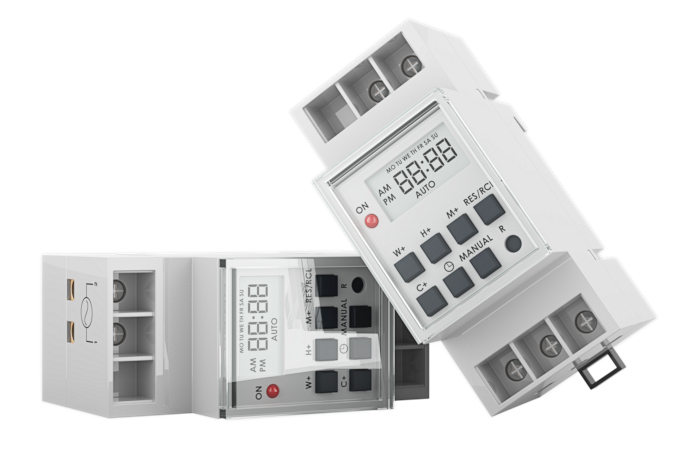
Because digital timers are powered by electricity, they are also known as electrical timer switches. Instead of mechanical parts, they use a microcontroller to allow you to adjust the timing schedule with control buttons. Digital timers are more accurate and versatile with a wider range of options to customize schedules.
A photocell timer switch uses a sensor to detect available ambient light that, in turn, triggers the on/off schedule. Rather than having to manually set the timer to power on a lamp at sunset, a photocell timer comes on automatically when it gets dark enough, making it ideal for outdoor lighting for the home or street lighting, as well as for security lighting.
An astronomical timer switch is electronic and uses the position of the sun to set its timing. Astronomic timers have either a built-in memory or a software program that stores the scheduling data, which includes latitude, longitude, and other location-specific details. As a result, these timers can turn off devices by identifying and calculating sunrise and sunset.
Installation options
Timer switches can be installed in several ways. The most common methods are plug-in, DIN rail-mounted timers, and outdoor timers.
Plug-in timer switches are the most straightforward if you’re looking to control household appliances, such as heaters and lamps because they interface directly to standard electrical sockets.
A DIN rail-mounted timer is best suited for demanding industrial applications. Installed on DIN rails inside electrical enclosures, they enable you to control machinery and equipment reliably.
Harsh environments generally use outdoor timer switches to control exterior security systems, garden lighting, and other outdoor equipment.
Selecting a timer switch ultimately boils down to the necessary functions for your use case as well as the characteristics of the environment.
Use cases
Different types of timer switches have a wider range of use cases for homes, businesses, and municipalities.
Common outdoor applications include signage with lighting that must be scheduled and signs that must be visible at night or on overcast days while not using energy unnecessarily during daylight hours. In addition, these timers can be used to control swimming pool filtration systems and lighting. Other lighting that can use astronomic timer switches to control their schedules are streetlamps; they keep people safe while conserving energy.
Agriculture and landscaping irrigation systems can also be automatically controlled by a timer so that water is used more efficiently
Among the many indoor applications are motors in industrial machinery. Because the motors are controlled by a timer, energy use is optimized while reducing wear and tear to extend the lifespan of the equipment. Using timers to control water heaters also improves energy efficiency while ensuring that hot water is available when needed.
Heating, ventilation and air conditioning (HVAC) systems can also be controlled by timer switches so that they can optimally regulate indoor environments and minimize energy consumption to reduce utility bills.
Safety considerations
Every timer switch application has its own set of considerations, including those related to safety. Always follow the manufacturer’s instructions and guidance about where and how to install a timer switch. Never use an indoor switch for an outdoor application, and practice sound wiring techniques to avoid electrical hazards. Any timer switch should meet local electrical codes and be installed in a proper enclosure.