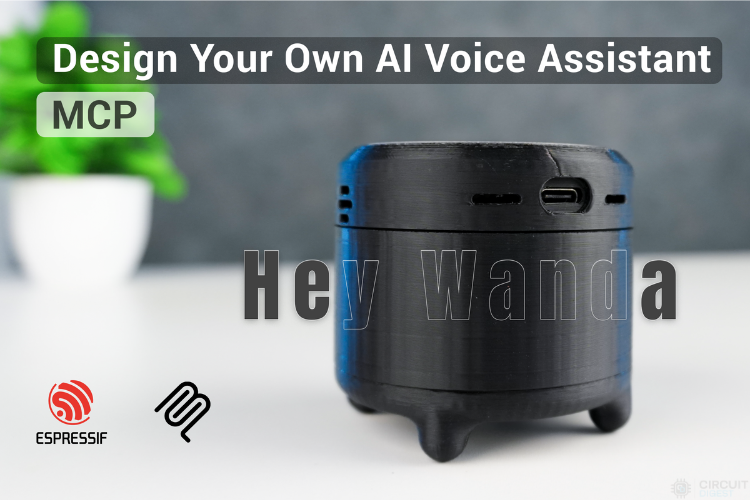
Build a compact, custom AI voice assistant using ESP32-S3 and Model Context Protocol (MCP) to enable natural language interaction and smart device control.
Introduction: A DIY AI Assistant for Makers
Voice assistants are everywhere—from smartphones to smart speakers—but what if you could build your own intelligent voice device that’s completely open, fully customizable, and respects your privacy? The ESP32 AI Voice Assistant with MCP Integration does exactly that. It’s a fully DIY voice assistant built around the powerful ESP32-S3 microcontroller, paired with the open-source Xiaozhi AI framework and an innovative Model Context Protocol (MCP) that lets AI interact directly with hardware.
This project blends embedded hardware design, real-time voice processing, and cloud-augmented AI to create a voice assistant that rivals commercial systems, without subscription fees or vendor lock-in. From hardware assembly to software setup and practical applications, this guide walks you through the journey of building your own voice-enabled AI assistant.
Why This Project Matters
Commercial voice assistants come with privacy concerns and limitations on customisation. In contrast, this DIY build offers:
- A fully custom hardware platform designed for makers.
- Natural voice interaction backed by cloud AI services.
- The ability to control smart home devices and sensors directly.
- A design that’s expandable and hackable for future maker tweaks.
This project demonstrates how even low-cost microcontrollers like the ESP32 can participate in advanced AI interactions when paired with the right protocols and frameworks
Core Architecture: Marrying Edge and Cloud Intelligence
At the heart of this assistant lies a hybrid architecture:
- ESP32-S3 Microcontroller – Handles local hardware tasks, wake-word detection, and audio streaming.
- Xiaozhi AI Framework – An open-source system that connects the assistant to powerful language models via the internet.
- Model Context Protocol (MCP) – A flexible communication layer between the AI and physical components, enabling hardware control from AI decisions.
This separation allows the ESP32 to remain responsive while delegating the heavy AI lifting—like speech-to-text and natural language processing—to cloud services.
How Voice Interaction Works
The voice assistant operates in a multi-stage interaction loop:
- Wake-Word Listening – A tiny neural network continuously listens for a trigger like “Hey Wanda” with minimal power draw.
- Audio Capture – Once activated, dual MEMS microphones pick up clear voice input, while built-in DSP routines reduce noise and echo.
- Streaming to AI Server – The audio is streamed to a server where high-accuracy speech-to-text converts it to text.
- AI Reasoning & MCP Actions – The text is processed by language models. If needed, MCP tells hardware (like relays or sensors) what to do.
- AI Response Playback – The server sends back an AI-generated reply, transformed into speech and played through the onboard speaker.
This pipeline allows real-time conversations, smart controls, and feedback with natural-sounding responses—like a commercial voice assistant, but fully under your control.
Understanding MCP: Bridging AI and Hardware
The Model Context Protocol (MCP) is a key innovation here. Think of MCP as a universal language that lets AI models know what hardware is available and how to control it. MCP supports:
- Device discovery: Identify connected components and sensors.
- Capability description: Understand what each component can do.
- Action execution: Trigger physical actions (like switching lights).
- State feedback: Report hardware status back to the AI.
This standardisation makes it easier for developers to add new peripherals or extend functionality without hacking protocols or custom APIs.
Building the Hardware
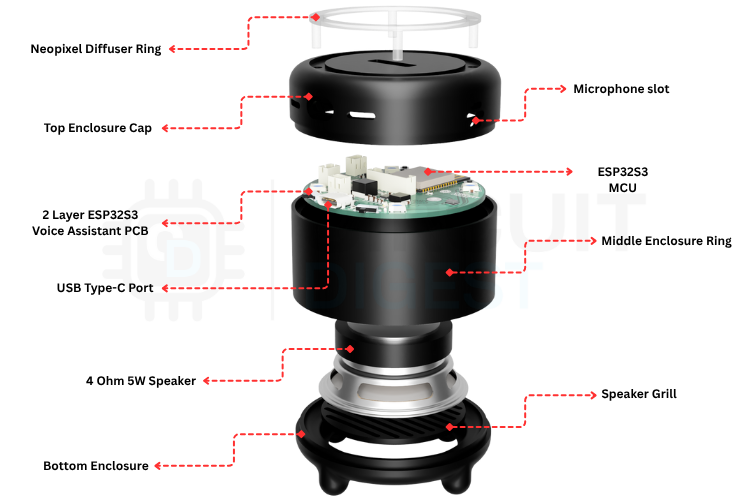
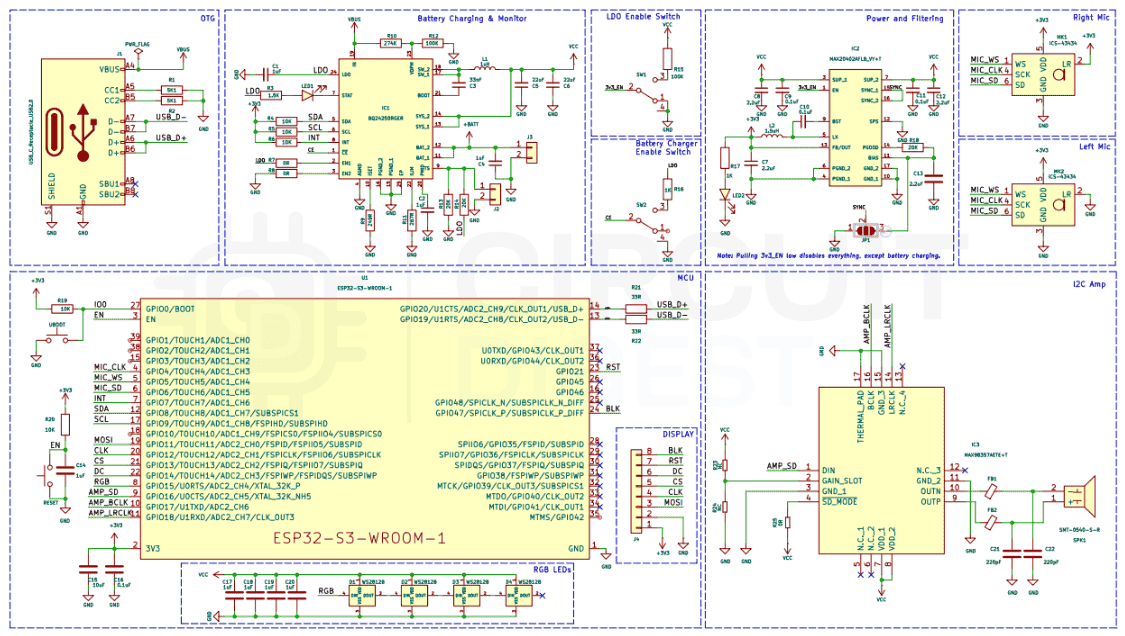
The custom board designed for this project includes:
- ESP32-S3-WROOM-1 for processing and connectivity.
- Dual IST digital MEMS microphones for clear voice capture.
- MAX98357A audio amplifier for responsive output.
- Power management circuitry for battery or USB operation.
- RGB LEDs, buttons, and switches for user interaction.
The PCB is optimised for stable performance and easy expandability, making it suitable as a desktop hub or wall-mounted assistant.
Software & Firmware Development
The voice assistant firmware is developed using ESP-IDF in Visual Studio Code, integrating:
- The Xiaozhi AI agent for cloud linkages.
- Real-time audio pre-processing and wake-word detection middleware.
- WebSocket communication with remote AI servers.
Configuring the environment, cloning the GitHub repository, and flashing the firmware are standard maker workflows. Once deployed, the device creates a Wi-Fi interface for initial setup and network configuration.
Practical Applications and Extensions
With this foundation, the assistant supports:
- Smart home voice control (lights, climate, appliances).
- Sensor integration (temperature, motion, etc.).
- Custom voice commands for actions or queries.
- Enhanced accessibility for hands-free interactions.
Future enhancements could include camera support, expanded sensor arrays, or improved audio quality—all supported by the MCP-enabled architecture.
Conclusion: Open AI for the Maker Community
The ESP32-S3 AI Voice Assistant with MCP Integration showcases how embedded systems can participate in sophisticated AI tasks. By blending low-power hardware with cloud-driven intelligence and a protocol that bridges AI and physical devices, this project invites makers to innovate beyond traditional IoT boundaries.