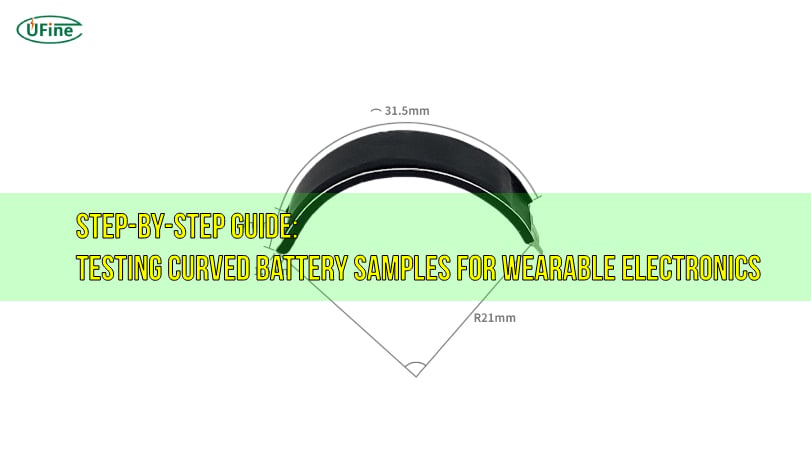
Curved batteries are becoming a key part of next-generation wearables. As devices get smaller, lighter, and more flexible, engineers and makers need batteries that fit into curved, ergonomic casings—without compromising safety or performance.
At Ufine Battery, we’ve spent years testing and improving custom-shaped battery cells. As a lithium battery manufacturer focused on wearable devices, we often work directly with engineers who need to evaluate curved cell performance in real use cases. That’s why we put together this step-by-step guide to help you test curved batteries in your lab or workshop.
Whether you’re designing a fitness tracker or a flexible medical sensor, this guide covers the essential tools, methods, and checks for mechanical and electrical testing of curved lithium batteries.
1. Mechanical Bend-Cycle Testing Setup
The first and most obvious concern with curved batteries is mechanical durability. Can they handle repeated bending without swelling, leaking, or losing capacity?
What You’ll Need:
- A programmable bending machine or a custom servo setup
- 3D-printed fixtures to hold the battery securely
- Bending radius templates (e.g., 20mm, 30mm, etc.)
- Infrared thermometer or thermal camera
- Safety gloves and a fireproof container (just in case)
Test Method:
- Fix the curved battery between two holding arms. One arm remains static, the other moves to create the desired bend.
- Set a controlled bend radius and cycle rate (e.g., 1Hz = 1 bend per second).
- Perform 1,000 to 5,000 cycles while logging voltage and surface temperature.
- Stop the test immediately if swelling, overheating, or electrolyte leakage is observed.
Goal: The battery should maintain shape and electrical performance without visible or thermal damage.
2. Capacity Fade and Internal Resistance Measurements
Curved cells experience stress that can impact long-term electrochemical stability. After mechanical testing, it’s important to check battery health using basic electrical tests.
Tools Required:
- Battery analyser (e.g., BK Precision, Arbin, or similar)
- Multimeter with milliohm range
- Lab power supply (for charging at constant current/voltage)
- Balance charger for safe charging/discharging
Steps:
- Fully charge the battery under test to its nominal voltage.
- Run three full charge-discharge cycles at rated current (e.g., 0.5C or 1C).
- Measure:
- Capacity retention (mAh)
- IR (internal resistance) after each cycle
- Any abnormal voltage drop under load
- Compare this data to the battery’s datasheet (if available) or previous flat cell benchmarks.
Expected Result: A high-quality curved cell should show minimal capacity fade and stable internal resistance after normal mechanical stress.
Many wearables operate in outdoor or high-humidity environments. You'll want to check how well your battery samples resist moisture and dust.
While complete IP testing usually requires lab-grade equipment, you can run basic tests in-house:
Simple IPX4 Water Spray Test:
- Place your battery in a test enclosure (if applicable)
- Spray from different angles using a low-pressure nozzle or fine mist bottle
- Observe the battery surface and terminals for leakage or changes in insulation
- Run electrical tests after exposure to confirm integrity
Condensation Test (DIY):
- Place the battery in a sealed container with high humidity (~90%) for 12-24 hours
- Use silica gel and temperature sensors to monitor the environment
- After removal, dry the battery and re-test the capacity and voltage. If necessary, consider conformal coatings or sealed battery pouches.
Suppose you're designing for IP67 or hatches. At Ufine, we often add custom sealing layers for customers needing waterproof or sweatproof cells.
Many wearables operate in outdoor or high-humidity environments. You'll want to check how well your battery samples resist moisture and dust.
While complete IP testing usually requires lab-grade equipment, you can run basic tests in-house:
Simple IPX4 Water Spray Test:
- Place your battery in a test enclosure (if applicable)
- Spray from different angles using a low-pressure nozzle or fine mist bottle
- Observe the battery surface and terminals for leakage or changes in insulation
- Run electrical tests after exposure to confirm integrity
Condensation Test (DIY):
- Place the battery in a sealed container with high humidity (~90%) for 12-24 hours
- Use silica gel and temperature sensors to monitor the environment
- After removal, dry the battery and re-test the capacity and voltage. Consider conformal coatings or sealed battery pouches if necessary.
Suppose you're designing for IP67 or hatches. At Ufine, we often add custom sealing layers for customers needing waterproof or sweatproof cells.
Many wearables operate in outdoor or high-humidity environments. You'll want to check how well your battery samples resist moisture and dust.
While complete IP testing usually requires lab-grade equipment, you can run basic tests in-house:
Simple IPX4 Water Spray Test:
- Place your battery in a test enclosure (if applicable)
- Spray from different angles using a low-pressure nozzle or fine mist bottle
- Observe the battery surface and terminals for leakage or changes in insulation
- Run electrical tests after exposure to confirm integrity
Condensation Test (DIY):
- Place the battery in a sealed container with high humidity (~90%) for 12-24 hours
- Use silica gel and temperature sensors to monitor the environment
- After removal, dry the battery and re-test the capacity and voltage. Consider conformal coatings or sealed battery pouches if necessary.
Suppose you're designing for IP67 or hatches. At Ufine, we often add custom sealing layers for customers needing waterproof or sweatproof cells.
Want to automate your test process or collect detailed logs over time? A microcontroller setup is a simple and low-cost way to track key battery parameters.
Hardware:
- Arduino Nano, ESP32, or Raspberry Pi
- INA219 or MAX17043 battery fuel gauge module
- MicroSD card module (for data logging)
- Optional: OLED display for real-time readout
What You Can Monitor:
- Voltage
- Current draw
- Temperature (using NTC thermistor or DS18B20)
- Estimated state of charge
Sample Use Case:
- Mount the curved cell inside your wearable prototype.
- Connect sensors and log data over 48-72 hours in real use conditions (walking, sweating, charging, etc.)
- Check for voltage dips, abnormal heating, or inconsistent current drain.
At Ufine Battery, we often send out early samples to clients with similar Arduino-based loggers so they can test performance on-site, before moving to mass production.
You may wonder why a company like ours is focused on curved batteries.
While we're not China's biggest lithium battery manufacturer, we pride ourselves on customisation. We provide OEM and ODM services, and our catalogue includes:
- Lithium-ion batteries
- LiFePO₄
- 18650 cells
- High-temp/low-temp batteries
- Ultra-thin and high-rate cells
Unlike large brands that require bulk orders, Ufine allows small MOQ—even just one piece for custom samples. This is great for early-stage startups, labs, and hardware teams.
Our team responds quickly, ships fast, and offers a one-year warranty on all models. Whether you need a curved cell for medical wearables or flexible sensors, we help you move from idea to prototype quickly.
You may wonder why a company like ours is focused on curved batteries.
While we're not China's biggest lithium battery manufacturer, we pride ourselves on customisation. We provide OEM and ODM services, and our catalogue includes:
- Lithium-ion batteries
- LiFePO₄
- 18650 cells
- High-temp/low-temp batteries
- Ultra-thin and high-rate cells
Unlike large brands that require bulk orders, Ufine allows small MOQ—even just one piece for custom samples. This is great for early-stage startups, labs, and hardware teams.
Our team responds quickly, ships fast, and offers a one-year warranty on all models. Whether you need a curved cell for medical wearables or flexible sensors, we help you move from idea to prototype quickly.
Final Thoughts: Iterate and Share
Testing curved batteries isn't just about safety—it's about understanding how batteries behave in new environments and form factors. As wearables and flexible electronics grow, more makers will need to validate curved cells in their own designs.
By combining mechanical, electrical, and environmental tests with simple logging tools like Arduino or Raspberry Pi, you can gain real insights and avoid surprises later.
At Ufine, we’re always exploring new materials and methods to improve curved batteries. If you have a project that needs a custom shape or special performance, feel free to reach out. We're happy to share what we’ve learned—and learn from you, too.