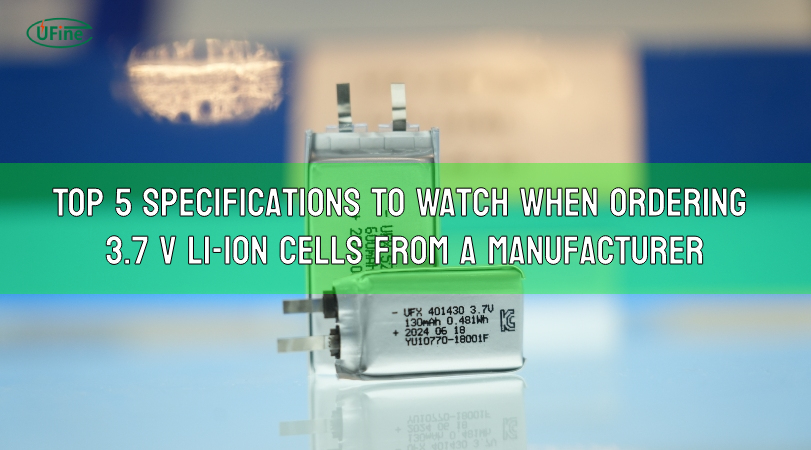
Reliable 3.7 V Li-ion batteries are key to powering hardware projects. This article explains five critical specs to know before ordering, helping you choose the right cells for performance and production success.
If you’re building a hardware project, whether it's a smart wearable, sensor node, or robotics prototype, powering it safely and efficiently matters just as much as the code that runs it. At the center of it all is one critical component: the 3.7 V lithium-ion battery.
But not all batteries are the same. Even with the same voltage and form factor, cells from different suppliers can vary significantly in quality, performance, and lifespan. That’s why choosing the right lithium battery manufacturer is so important, especially when your project moves beyond prototyping into production.
In this article, we’ll break down the five most important specifications you should understand before ordering 3.7 V Li-ion cells—and how they impact the real-world performance of your devices.
1. Capacity (mAh): It’s Not Just a Number
Battery capacity, expressed in milliamp-hours (mAh), is often the first number engineers examine. It tells you how much charge the battery can store and roughly how long your device can run.
But here’s the catch: manufacturers often measure capacity under ideal lab conditions, such as discharging at 0.2C at room temperature. In real-world use, especially with fluctuating loads or extreme temperatures, actual usable capacity can drop significantly.
What to Look for:
- Nominal vs. actual capacity: Ask for discharge curves at different C-rates.
- Tolerance range: Some manufacturers allow up to ±5% variation, others ±10%.
- Temperature performance: Low temperatures can reduce effective capacity by up to 30%.
⚙️ For IoT and wearables, a 500 mAh cell that performs reliably at 0°C is better than a 600 mAh cell that struggles below 20°C.
2. Discharge Rate (C-Rate): Match Your Load Profile
The discharge rate, or C-rate, determines how much current you can draw from the battery without overheating or causing voltage drops. A 1C discharge on a 2000 mAh battery means you can draw 2000 mA (2A) continuously.
Choosing the wrong discharge rate can lead to poor performance or, worse, safety issues.
What to Look for:
- Continuous vs. peak discharge: Some cells allow short bursts at higher rates.
- Internal resistance: Higher resistance = higher voltage drop under load.
- Thermal behavior: At high C-rates, batteries heat up. Ask for thermal test data.
🚗 If you're building a robot or drone, opt for high-rate cells that support 10C or higher, depending on your motors.
🧪 Tip: Always test your actual load with a dummy cell before finalizing specs.
3. Cycle Life: How Long Will It Last?
Cycle life is the number of full charge/discharge cycles a battery can handle before its capacity drops to 80% of its original value. For standard 3.7 V Li-ion cells, cycle life ranges from 300 to 1000 cycles depending on chemistry, charge protocol, and use conditions.
But that’s just the surface.
What to Look for:
- Charge cut-off and end-of-discharge voltage: Charging to 4.2 V vs. 4.1 V can significantly affect longevity.
- Depth of Discharge (DoD): Shallower cycles extend life.
- Test reports: Look for real test data—not just catalog specs.
🔋 Ufine Battery, for example, shares lab cycle testing data for both standard and high-cycle cells, which helps engineers plan battery replacement schedules in long-life products.
4. Temperature Range: Performance Across Conditions
If your device operates outdoors or in industrial environments, don’t ignore temperature specs. Standard 3.7 V cells often have an operating range from 0°C to 45°C (charge) and -20°C to 60°C (discharge).
But for some applications—like cold chain logistics or outdoor sensors—this range isn’t enough.
What to Look for:
- Operating range (charge/discharge): Some batteries support -40°C or +70°C.
- Capacity at low temp: Check for 25°C vs. -20°C capacity comparison.
- Cell expansion behavior: Important for embedded packs in sealed enclosures.
🌡️ Ufine produces low-temperature Li-ion batteries and high-temperature cells specifically for harsh environments. These are ideal for devices used in extreme climates or industrial applications.
5. Customization & Protection: Often Overlooked, Always Important
Even the best battery is useless if it doesn’t fit your device—or worse, fails without protection.
Custom battery packs, connectors, or protection circuits (PCM/BMS) are often required for safety and compatibility. Yet many engineers treat this as an afterthought.
What to Look for:
- Custom shapes or thin-cell formats: For wearables or smart cards.
- Integrated PCM/BMS: Protects against overcharge, over-discharge, and short-circuits.
- Connector support: JST, Molex, and solder tabs—check before ordering.
🧩 Here’s where Ufine Battery really stands out:
Unlike big-name factories that require large MOQs, Ufine accepts single-unit orders, responds quickly to design needs, and offers full OEM/ODM support. That makes it perfect for startups, labs, or indie hardware projects.
How to Choose the Right Manufacturer?
Beyond specs, look at service:
- Do they provide datasheets and real test data?
- Can they deliver small samples fast?
- Do they support design changes or small-batch prototyping?
- How responsive is their support team?
A good lithium battery manufacturer should be more than a supplier—they should be your engineering partner.
✅ Ufine Battery may not be the biggest player in the market, but for custom cells, small MOQs, and responsive support, it’s a strong choice for makers and engineers alike. It also provides a one-year warranty and fast lead time, which can keep your project on schedule.
Summary: Battery Specs That Matter
Bonus: Where Are 3.7 V Li-ion Batteries Used?
Understanding the application helps refine the specs you need. Here are a few examples:
- 🛠 Wearables: Ultra-thin Li-ion with PCM and tight voltage control
- 🛰 IoT Sensors: Low-temp cells with extended standby
- 🎮 DIY Electronics: 18650s or pouch cells with JST connectors
- 🔬 Medical Devices: Custom-sized packs with safety certification
- 🚗 RC/Drones: High-rate discharge and short recharge cycles
Final Words
No matter how good your PCB layout or firmware is, the battery is still the heart of your product. Read the specs, talk to your supplier, and test in real conditions.
A trusted manufacturer, like Ufine Battery, can make your life easier by offering reliable specs, fast support, and the flexibility to adapt to your project needs—whether you're building one unit or scaling to thousands.
If you’re not sure where to start, request a few sample cells. Test them under your expected load, and don’t hesitate to ask for help. A good partner will always support your design journey.