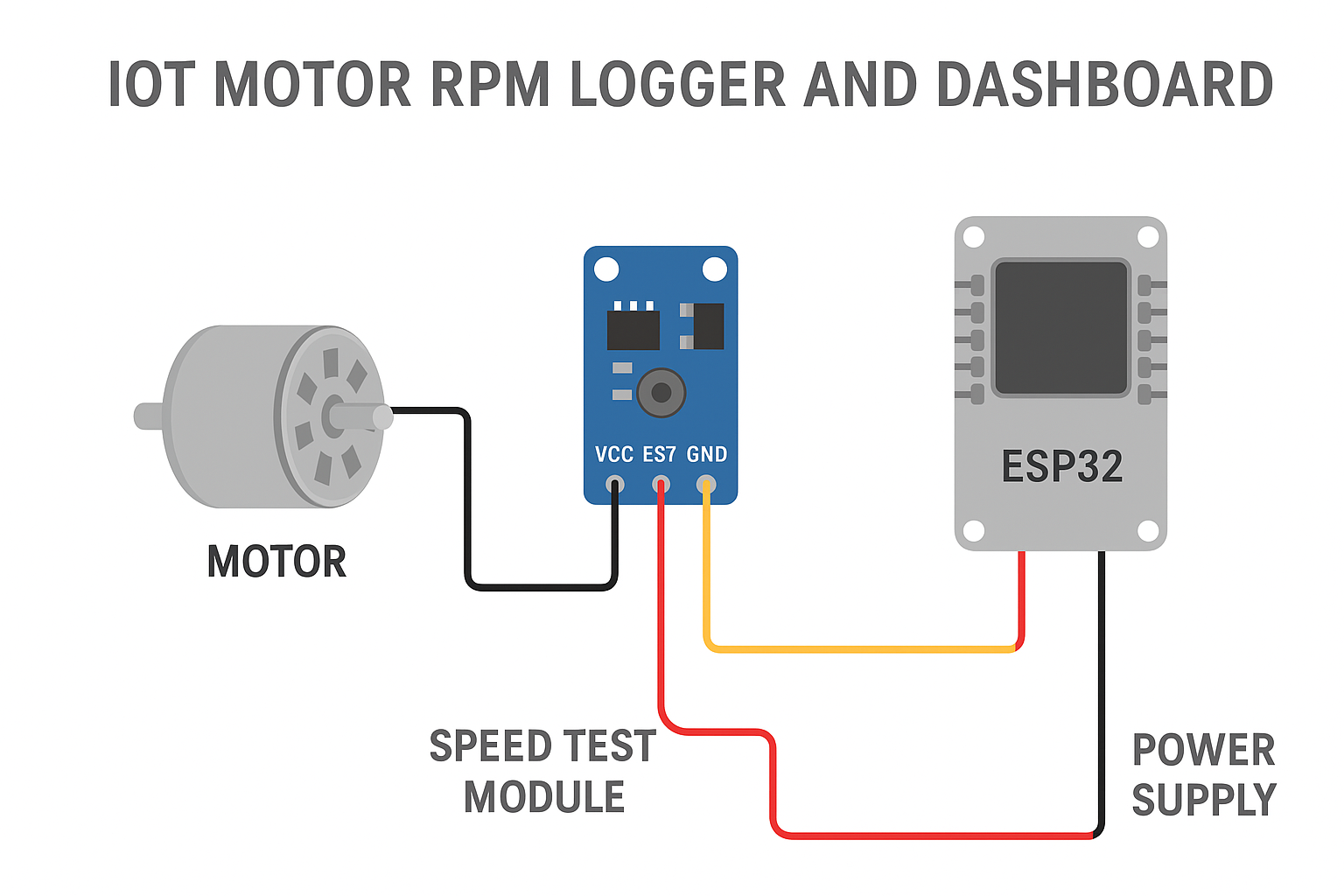
Measuring the speed of a motor is essential in robotics, automation, and performance monitoring. This project demonstrates how to build an IoT-enabled RPM (revolutions per minute) logger that uses a motor speed test module to sense rotation, then calculates RPM using a microcontroller. The results are displayed locally and sent wirelessly to a dash
How It Works
The speed test module generates digital pulses whenever the motor’s code disc interrupts the sensor beam. These pulses are counted by the microcontroller using an interrupt pin. By counting pulses over a known time interval, we can calculate the motor’s RPM with good accuracy. The system then publishes these values via WiFi for remote visualization.
Components Required
- Motor with code disc or slotted wheel
- Speed test module (IR slotted sensor)
- ESP32 or ESP8266 microcontroller (WiFi enabled)
- Breadboard and jumper wires
- Power supply for motor and MCU
- Optional: OLED display, SD card module for logging
Circuit Diagram
- Connect the OUT pin of the speed test module to an interrupt-capable pin on the ESP32.
- VCC → 3.3V (or 5V depending on module spec).
- GND → common ground.
- Motor powered separately but shares ground with ESP32.
Working Principle
- Pulse Counting
- Each slot in the rotating disc generates one pulse. An interrupt service routine increments a counter every time the signal changes.
- RPM Calculation
- Every second, the system reads the pulse count and computes RPM:
- RPM=pulseCount×60measurement interval (s)RPM = \frac{\text{pulseCount} \times 60}{\text{measurement interval (s)}}RPM=measurement interval (s)pulseCount×60
- Data Transmission
- The calculated RPM is published over MQTT or HTTP to a server, dashboard, or IoT platform.
- Visualization
- A web dashboard (built with Chart.js or similar) displays the live RPM graph, min/max values, and logs historical data.
Testing & Results
- The RPM values appear on the serial monitor.
- MQTT dashboard shows live data.
- System responds well to speed variations.
- With an OLED display, you can monitor locally without a PC.
Future Enhancements
- Add SD card logging for offline storage.
- Set threshold-based alerts (buzzer or email).
- Monitor multiple motors simultaneously.
- Build a mobile app interface for control and monitoring.
Conclusion
This project takes a simple motor speed test module and transforms it into a complete IoT monitoring tool. It is practical for DIY automation, robotics, and educational experiments where motor performance must be tracked in real time.
For more details about the speed test module itself, check this reference:
Speed Test Module for Motor RPM Measurement