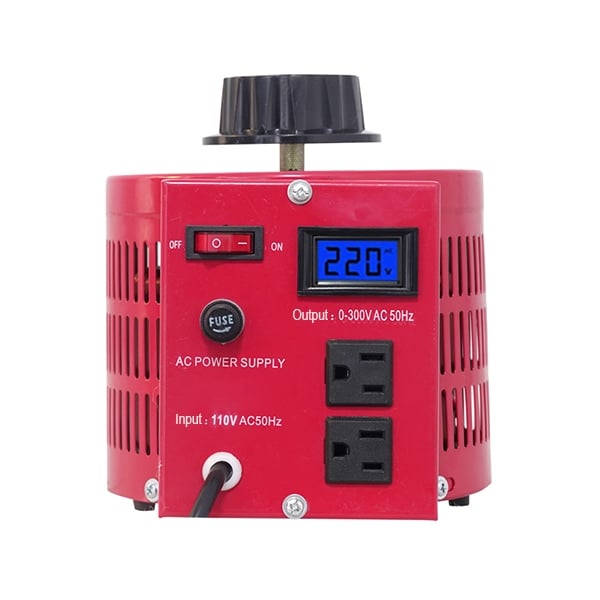
Depending on the power supply system and output method, variac transformers can be mainly divided into single-phase variac transformers and three-phase variac transformers. While both employ similar basic voltage regulation principles, they differ significantly in the number of power phases, circuit structure, load type, and application scenarios.
A variac transformer is an electrical device capable of continuously regulating AC output voltage. Unlike ordinary transformers with a fixed output voltage, variac transformers allow the output voltage to vary continuously within a specified range by changing the effective number of winding turns through an adjusting mechanism. Therefore, they are widely used in electrical testing, equipment commissioning, laboratory power supplies, motor testing, and industrial power control.
Depending on the power supply system and output method, variac transformers can be mainly divided into single-phase variac transformers and three-phase variac transformers. While both employ similar basic voltage regulation principles, they differ significantly in the number of power phases, circuit structure, load type, and application scenarios. Understanding these differences helps in determining the appropriate adjustable AC power supply type for the actual electrical system.
What is a Single-Phase Variac Transformer?
A single-phase variac transformer is primarily used for continuous regulation of single-phase AC voltage. Both its input and output are single-phase AC systems. The output voltage is changed by altering the effective number of winding turns through adjustable contacts. When the adjustment knob or mechanism moves, the number of turns in the winding corresponding to the output terminal changes, and the output voltage changes accordingly.
Single-phase variac transformers have a relatively simple structure, suitable for testing and control scenarios requiring a single adjustable AC power supply. In the laboratory, they can be used for voltage testing of electronic equipment, electrical components, lighting equipment, and other single-phase loads. During equipment maintenance and commissioning, the operating status of the equipment under different power supply conditions can be observed by gradually changing the input voltage.
For applications requiring the simulation of different AC power supply conditions, single-phase variac transformers offer a more flexible testing method than fixed-voltage power supplies. Users do not need to frequently change power supplies of different voltage levels; they only need to adjust the output to obtain the corresponding AC voltage.
What is a Three-Phase Variac Transformer?
A three-phase variac transformer is primarily used for continuous regulation of three-phase AC voltage. Unlike single-phase Variacs, three-phase Variacs need to handle three AC power supplies with fixed phase relationships simultaneously, therefore their internal structure and voltage regulation control are more complex.
Three-phase power supplies are widely used in industrial motors, automation equipment, and large electrical loads. For these devices, the correct voltage and phase relationships must be maintained between the three phases. If the three-phase input voltage needs to be changed during testing, adjusting each phase individually using only ordinary single-phase voltage regulators would increase the complexity of system control and synchronization. Three-phase variac transformers are designed for three-phase AC systems, providing adjustable AC output suitable for three-phase loads.
Three-phase variac transformers are commonly used in three-phase motor testing, industrial equipment commissioning, automation equipment testing, electrical experiments, and three-phase AC power supply simulation. By continuously adjusting the three-phase output voltage, the operating status of motors and other three-phase loads under different power supply conditions can be observed.
Difference between Single-Phase and Three-Phase Variac Transformers
The most direct difference is the number of power phases. Single-phase variac transformers are used in single-phase AC systems, primarily handling one AC voltage. Three-phase variac transformers are used in three-phase AC systems, requiring simultaneous handling of all three phases. Therefore, the difference is not simply a matter of power output, but rather a correspondence to different electrical system structures.
Load type is also an important difference. Single-phase Variacs are more commonly used in the testing and commissioning of laboratory equipment, electronic devices, lighting equipment, and single-phase electrical equipment. Three-phase Variacs are more suitable for three-phase motors, industrial machinery, automated production equipment, and other three-phase AC loads.
During voltage regulation, single-phase Variacs only need to control the single-phase output voltage, while three-phase Variacs need to consider the coordination relationship between the three phases. Therefore, the structure, control method, and application requirements of three-phase Variacs are usually more complex.
Application of Single-Phase and Three-Phase Variac Transformers
Single-phase variac transformers primarily address the continuous regulation of single-phase AC voltage, while three-phase variac transformers primarily address the continuous regulation of three-phase AC voltage.
If the equipment under test uses a single-phase AC power supply, then a single-phase variac transformer is typically used for its power supply structure. It can be used for voltage regulation, performance testing, and troubleshooting of single-phase equipment.
If the equipment uses a three-phase AC power supply, such as a three-phase motor or industrial drive equipment, then a three-phase variac transformer needs to be considered. At this point, voltage regulation involves not only output voltage changes but also maintaining the normal electrical relationship between the three-phase power supplies to meet the operational and testing requirements of the three-phase load.
It's important to note that variac transformers typically employ an autotransformer structure, whose primary function is continuous AC voltage regulation, and is not equivalent to an isolation transformer. The input and output of an autotransformer are electrically connected; therefore, if the application requires both AC voltage regulation and input-output electrical isolation, alternative isolation solutions must be considered based on the specific system requirements.
PowerHome provides single phase and three phase variac transformers power regulation solutions for scenarios such as experimental testing, electrical maintenance, equipment commissioning, motor testing, and industrial power control. Through single-phase and three-phase AC voltage regulation configurations, adjustable voltage requirements under different power supply systems can be covered, providing flexible power testing and regulation methods for devices that require continuous changes in AC input conditions.