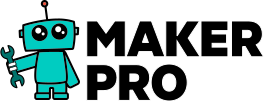
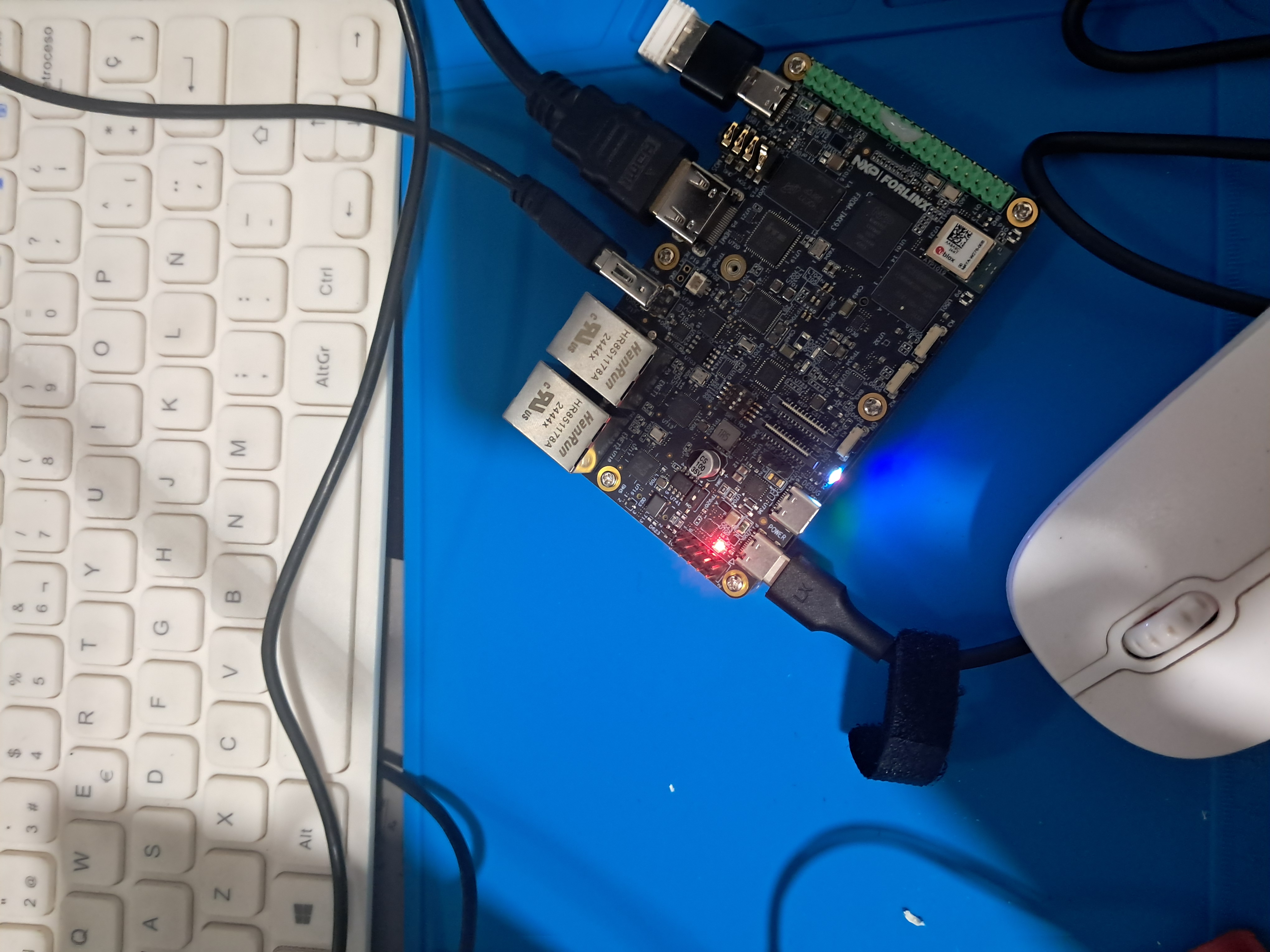
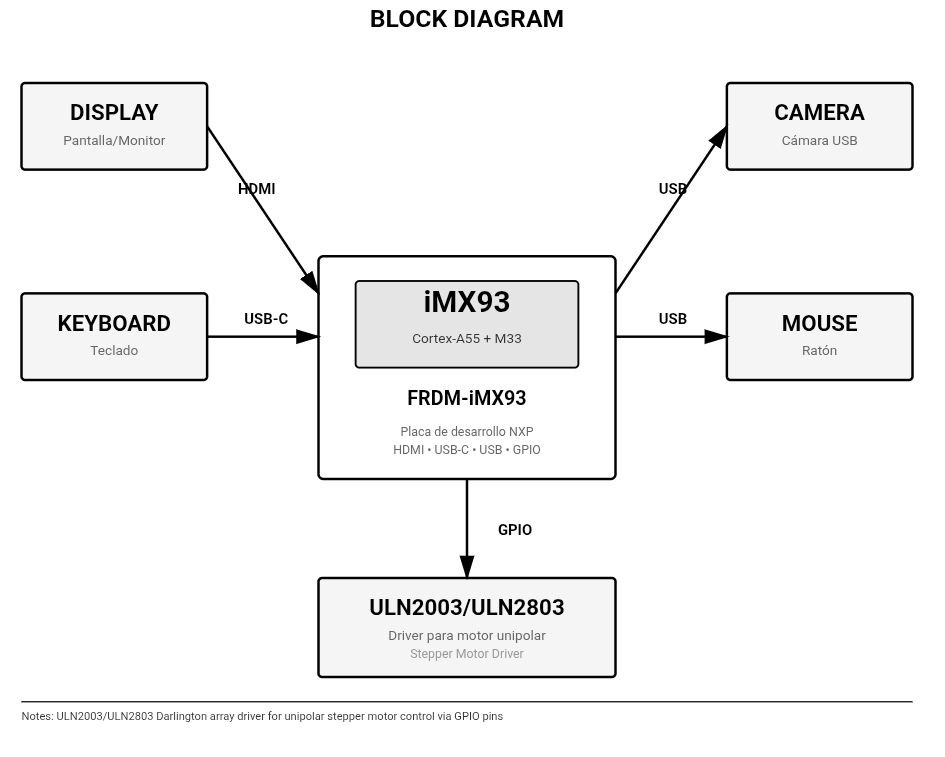
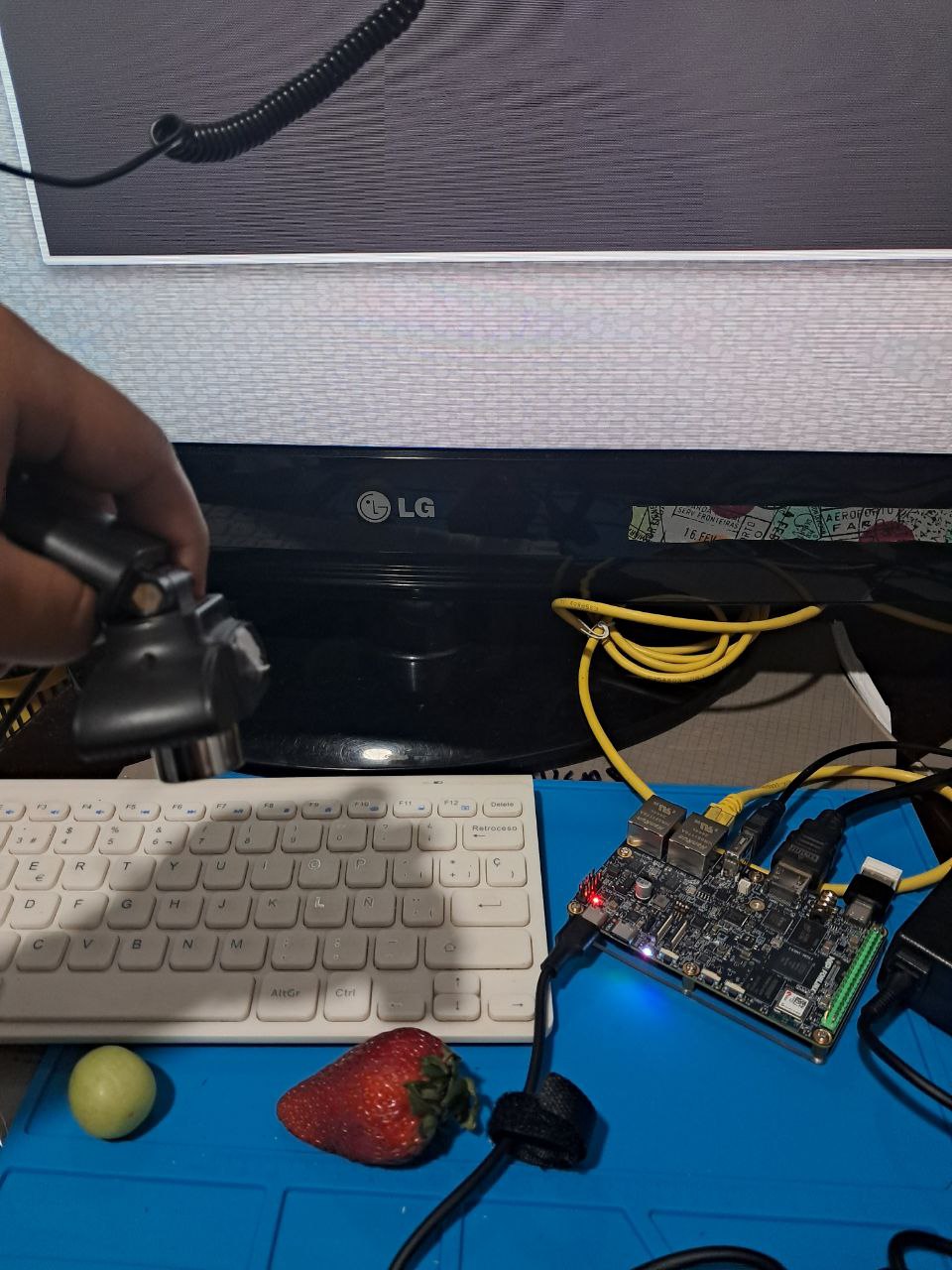
This project presents an automatic fruit classification and movement control system based on the NXP FRDM-i.MX93 development board.
The system uses TensorFlow Lite to classify fruits in real time through a USB camera connected to the board’s Linux environment. Once a fruit is recognized, the platform automatically rotates a stepper motor (28BYJ-48)
Content goes hereNXP FRDM-i.MX93 development board
- Dual-core Arm® Cortex®-A55 + Cortex®-M33 architecture
- NPU (Neural Processing Unit) for accelerating machine learning inference
- HDMI output for video monitoring
- USB host port for camera connection
USB Camera
ULN2003 driver board
28BYJ-48 stepper motor
12 V power supply
- TensorFlow / TensorFlow Lite
- OpenCV (Python 3.10)
- Jupyter or Terminal (for testing)
- Linux environment on FRDM-i.MX93
System Operation
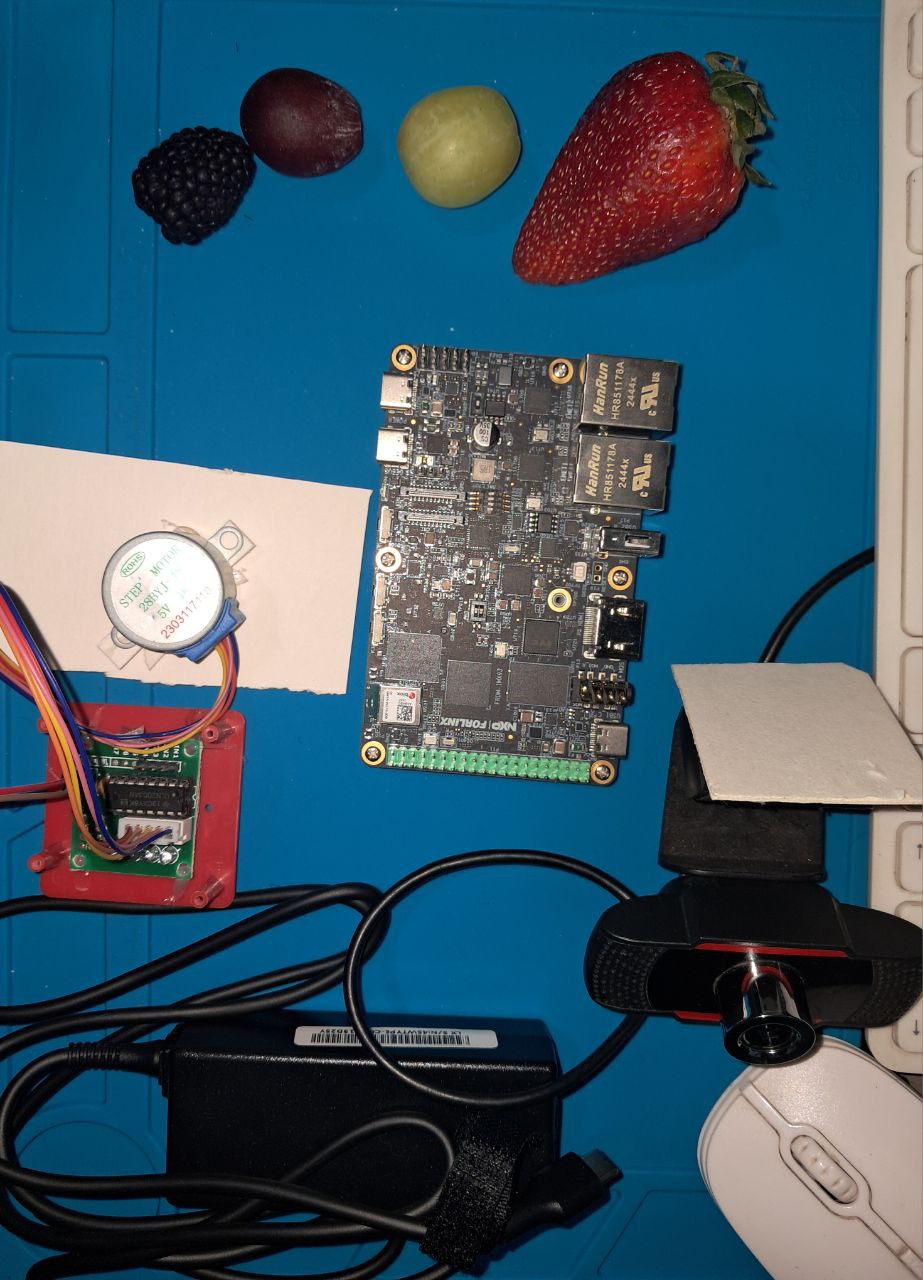
- The user first trains a Convolutional Neural Network (CNN) model in TensorFlow using a fruit dataset.
- The trained model is converted to TensorFlow Lite (.tflite) format for deployment on the FRDM-i.MX93.
- The Python script runs on the board, activating the USB camera to capture frames in real time.
- The model performs inference to identify the fruit type (e.g., apple, banana, orange, strawberry, etc.).
- The system repeats the process automatically.
- The system repeats the process automatically.
- The results are displayed in real time through HDMI output on an external monitor.
- TensorFlow / TensorFlow Lite
- OpenCV (Python 3.10)
- Jupyter or Terminal (for testing)
- Linux environment on FRDM-i.MX93
Possible Improvements
- Content goes Replace the USB camera with a higher-performance MIPI or NXP camera, such as the NXP eIQ Camera Module, for faster frame capture and better image quality.
- Implement a GUI-based control using PyQt or Tkinter for manual override or calibration.
- Integrate the system with a conveyor belt for industrial fruit sorting.
- Add cloud connectivity via MQTT or Edge Impulse integration for data storage and analytics.
Conclusion
The FRDM-i.MX93 development board is ideal for this project thanks to its dual-core heterogeneous architecture (A55 + M33), integrated NPU and advanced multimedia interfaces, connectivity, GPIO pins and compatibility with HDMI, USB, with all these features you will avoid using multiple development boards since this one has everything you need.