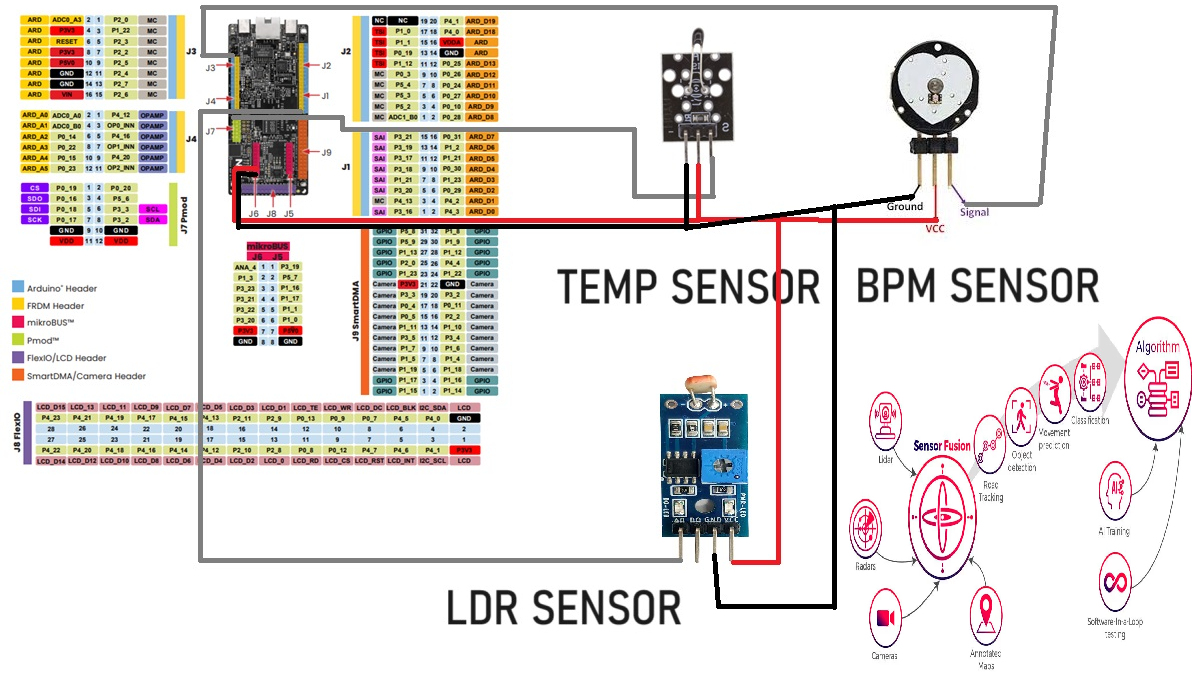
In this project, we will develop a sensor fusion system that integrates data from multiple sensors to provide accurate and reliable information about the environment. Sensor fusion combines the strengths of different sensor modalities, compensating for the limitations of individual sensors and improving overall system performance.
Objectives:
- Data Acquisition: Collect data from various sensors such as Temperature sensor, LDR sensor, BPM sensor, IMUs (Inertial Measurement Units), GPS, cameras, LiDAR, or radar. Each sensor provides different types of information, which, when combined, can give a comprehensive view of the environment.
- Preprocessing: Process raw sensor data to filter noise and correct errors. This step may include calibration, synchronization, and alignment of sensor data in a common reference frame.
- Fusion Algorithm Development: Develop algorithms to fuse data from different sensors. Techniques such as Kalman filtering, Bayesian networks, or deep learning models can be used depending on the application requirements. The goal is to integrate the data into a unified and coherent representation.
- Testing and Validation: Test the sensor fusion system in various scenarios to evaluate its performance. Compare the system's output with ground truth data to assess accuracy and reliability.
- Application Integration: Integrate the sensor fusion system into a target application, such as autonomous vehicles, robotics, or environmental monitoring. The system should provide real-time, reliable information to support decision-making processes in the application.
Expected Outcomes:
- A functional sensor fusion system that enhances the accuracy and reliability of sensor data.
- Documentation detailing the design, development, and testing processes.
- A final report summarizing the project outcomes, challenges encountered, and potential areas for future improvement.
This project is suitable for applications in autonomous systems, robotics, navigation, and any other fields where accurate environmental perception is critical.
Summary of ADC Sensing Theory
Analog-to-Digital Conversion (ADC) is a fundamental process in electronics that involves converting continuous analog signals into discrete digital values. This conversion is crucial in modern digital systems, where digital processing of real-world analog signals, such as temperature, sound, or light, is required.
Key Concepts:
Analog Signal:
- An analog signal is a continuous signal that varies over time and can take any value within a given range. Examples include the voltage output from a temperature sensor or the sound waves captured by a microphone.
Digital Signal:
- A digital signal is discrete, representing the analog signal in binary form (0s and 1s). The conversion process quantizes the continuous analog signal into a series of steps, each corresponding to a digital value.
Sampling:
- Sampling is the process of measuring the analog signal at regular intervals (sampling rate). The rate at which the signal is sampled must be sufficient to capture all the relevant information from the analog signal, according to the Nyquist-Shannon sampling theorem.
Quantization:
- Quantization refers to the process of mapping the sampled analog values to the nearest available digital levels. This introduces quantization error, which is the difference between the actual analog value and the quantized digital value.
Resolution:
- The resolution of an ADC is defined by the number of bits used to represent the digital output. For example, an 8-bit ADC has 256 discrete levels (2^8), while a 12-bit ADC has 4096 levels (2^12). Higher resolution provides more precise representation of the analog signal but may require more processing power and time.
Dynamic Range:
- Dynamic range is the ratio between the largest and smallest signal that an ADC can accurately convert. It is often expressed in decibels (dB) and is influenced by both the resolution and the reference voltage of the ADC.
Reference Voltage (V_ref):
- The reference voltage sets the maximum input voltage that the ADC can convert. The input analog signal is scaled relative to this reference voltage, with the digital output representing a fraction of this maximum value.
Conversion Speed:
- The conversion speed of an ADC is determined by the time it takes to complete a single analog-to-digital conversion. This speed is influenced by the type of ADC architecture (e.g., successive approximation, flash, sigma-delta) and the desired sampling rate.
Types of ADC Architectures:
- Successive Approximation Register (SAR) ADC: Balances speed and resolution, widely used in general-purpose applications.
- Flash ADC: Offers very high-speed conversion, typically used in high-frequency applications, but at the cost of lower resolution and higher power consumption.
- Sigma-Delta ADC: Provides high resolution and good noise performance, ideal for applications like audio processing, but generally slower.
Practical Considerations:
- Noise: Analog signals are susceptible to noise, which can affect the accuracy of the conversion. Proper signal conditioning, such as filtering and shielding, is necessary to minimize noise.
- Power Consumption: Higher-resolution and faster ADCs often consume more power, making the trade-off between performance and energy efficiency an important consideration in battery-powered devices.
- Calibration: Regular calibration is needed to ensure the accuracy of the ADC, compensating for any drift or variations in the reference voltage.
In summary, ADC sensing is a critical process in converting real-world analog signals into digital data that can be processed by digital systems. The choice of ADC type, resolution, and sampling rate depends on the specific requirements of the application, balancing accuracy, speed, and power consumption.
Use of ADC in Control Systems and Its Impact: A Summary
In control systems, Analog-to-Digital Converters (ADCs) play a crucial role in bridging the gap between the analog world and digital controllers. Many physical processes, such as temperature, pressure, and speed, produce analog signals. ADCs convert these continuous analog signals into discrete digital values that can be processed by digital control systems, such as microcontrollers or digital signal processors (DSPs).
Key Uses of ADC in Control Systems:
Sensor Data Acquisition:
- ADCs are used to convert analog signals from sensors (e.g., temperature sensors, pressure transducers, accelerometers) into digital data. This data is then fed into a controller, which uses it to make decisions and control the system.
Feedback Loop Processing:
- In closed-loop control systems, ADCs are essential for converting the feedback signals (e.g., output voltage, motor speed) into digital form. This allows the controller to compare the actual output with the desired setpoint and make necessary adjustments to maintain optimal performance.
Signal Conditioning and Filtering:
- ADCs work in conjunction with signal conditioning circuits to prepare the analog signal for accurate conversion. This includes filtering noise and adjusting signal levels, ensuring that the digital representation is as accurate as possible.
Digital Control Algorithms:
- Once the analog signals are digitized, they can be processed using advanced digital control algorithms, such as PID (Proportional-Integral-Derivative) controllers, state-space controllers, or adaptive control techniques. The digital nature allows for more complex and precise control strategies.
Impact of ADC in Control Systems:
Improved Accuracy and Precision:
- High-resolution ADCs enable precise measurement and control of analog signals, leading to more accurate system behavior and better performance in maintaining setpoints or tracking desired trajectories.
Real-Time Processing:
- Fast ADCs allow for real-time monitoring and control, essential in dynamic systems where immediate response to changes is required (e.g., automotive systems, industrial automation).
Increased System Flexibility:
- The digitization of analog signals enables the use of software-based control, which is easily modifiable and adaptable to different conditions without the need for extensive hardware changes.
Enhanced Noise Immunity:
- Digital processing of ADC outputs allows for sophisticated noise filtering and error correction techniques, improving the reliability and stability of the control system.
Cost and Power Efficiency:
- Integrating ADCs within microcontrollers or DSPs reduces the need for external components, saving on both cost and power consumption, which is particularly beneficial in embedded and portable control systems.
Conclusion:
ADCs are integral to the functioning of modern control systems, enabling the precise and efficient conversion of real-world analog signals into digital form for processing. Their use enhances the accuracy, flexibility, and overall performance of control systems, making them indispensable in applications ranging from industrial automation to consumer electronics.