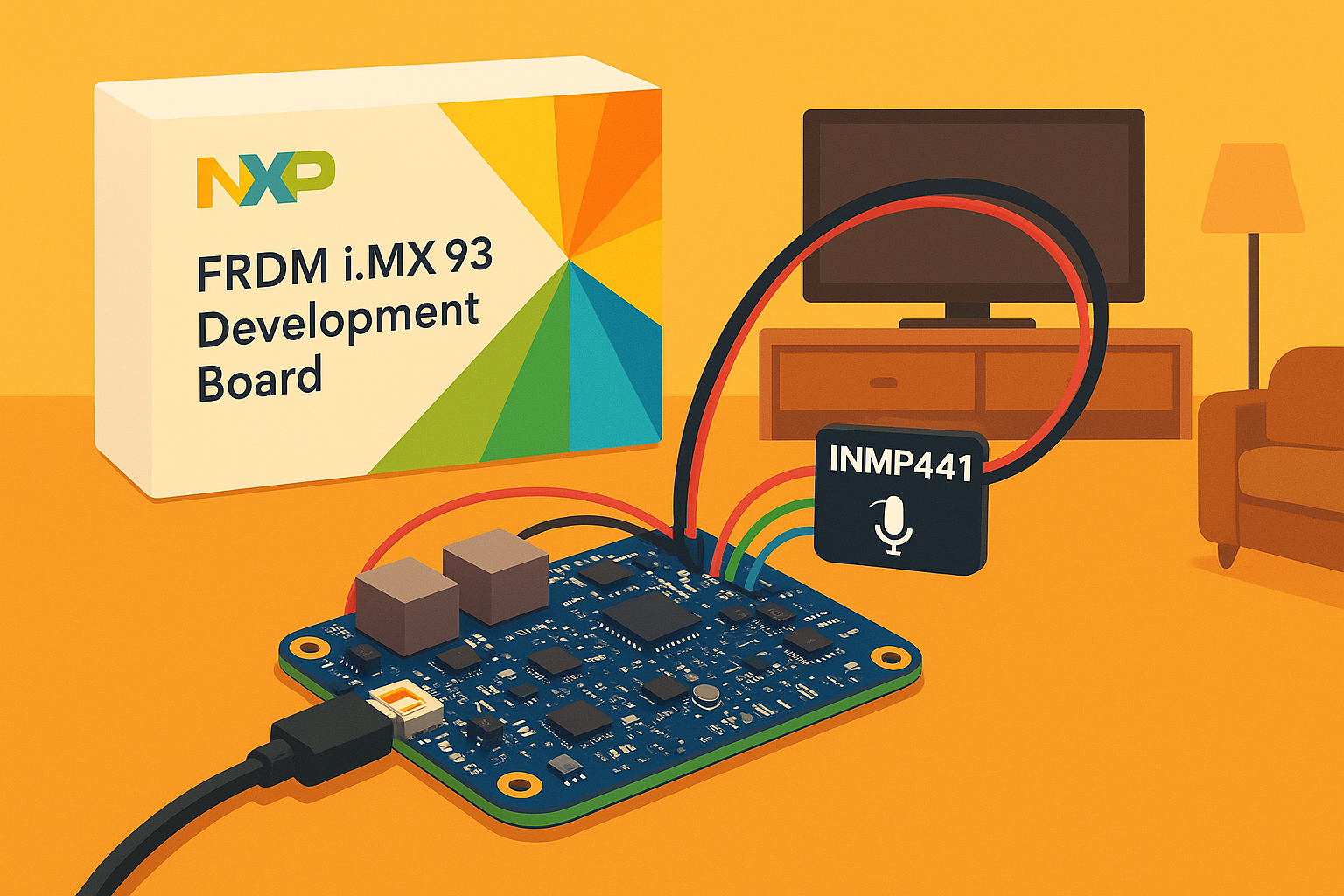
The project is a home security solution developed on top of the NXP FRDM-i.MX93 development board. In contrast to conventional systems based on motion or camera detection alone, this project utilizes audio to detect and react to real-world sound events — e.g., known voices, unfamiliar intruders, distress screams, and break-in sounds-in real-time.
NXP FRDM-i.MX93 Development Board
Serves as the main controller. Features dual Arm® Cortex®-A55 cores for Linux processing and an Arm® Ethos™-U65 microNPU for edge ML inference. Handles sound classification and alert generation.
INMP441 Digital I²S Microphone
Omnidirectional MEMS microphone that continuously captures ambient audio. Connects to FRDM-i.MX93 via I²S for high-quality digital audio input.
MicroSD Card (8GB or higher)
Stores sound data, ML models, and logs. Useful for collecting samples and retraining models.
5V USB-C Power Supply
Powers the FRDM-i.MX93 board and peripherals. Ensures stable power for continuous monitoring.
Wi-Fi or Ethernet
Enables network connectivity for sending alerts, firmware updates, or cloud integration if required.
Buzzer / Speaker
Generates audible alerts during suspicious activity or emergencies.
LED Indicator
Provides visual indication of system state (Listening, Alert, or Error).
Software Components
Operating System:
NXP i.MX93 Linux BSP
AI Framework:
NXP eIQ / TensorFlow Lite Micro
Programming Languages:
Python, C/C++
DSP / Feature Extraction:
MFCCs, FFT-based feature generation
Communication:
I²S (audio input), GPIO (LED/Buzzer alerts)
Model Deployment:
Quantized TFLite model optimized using Arm NN for Ethos-U65 NPU
System Overview
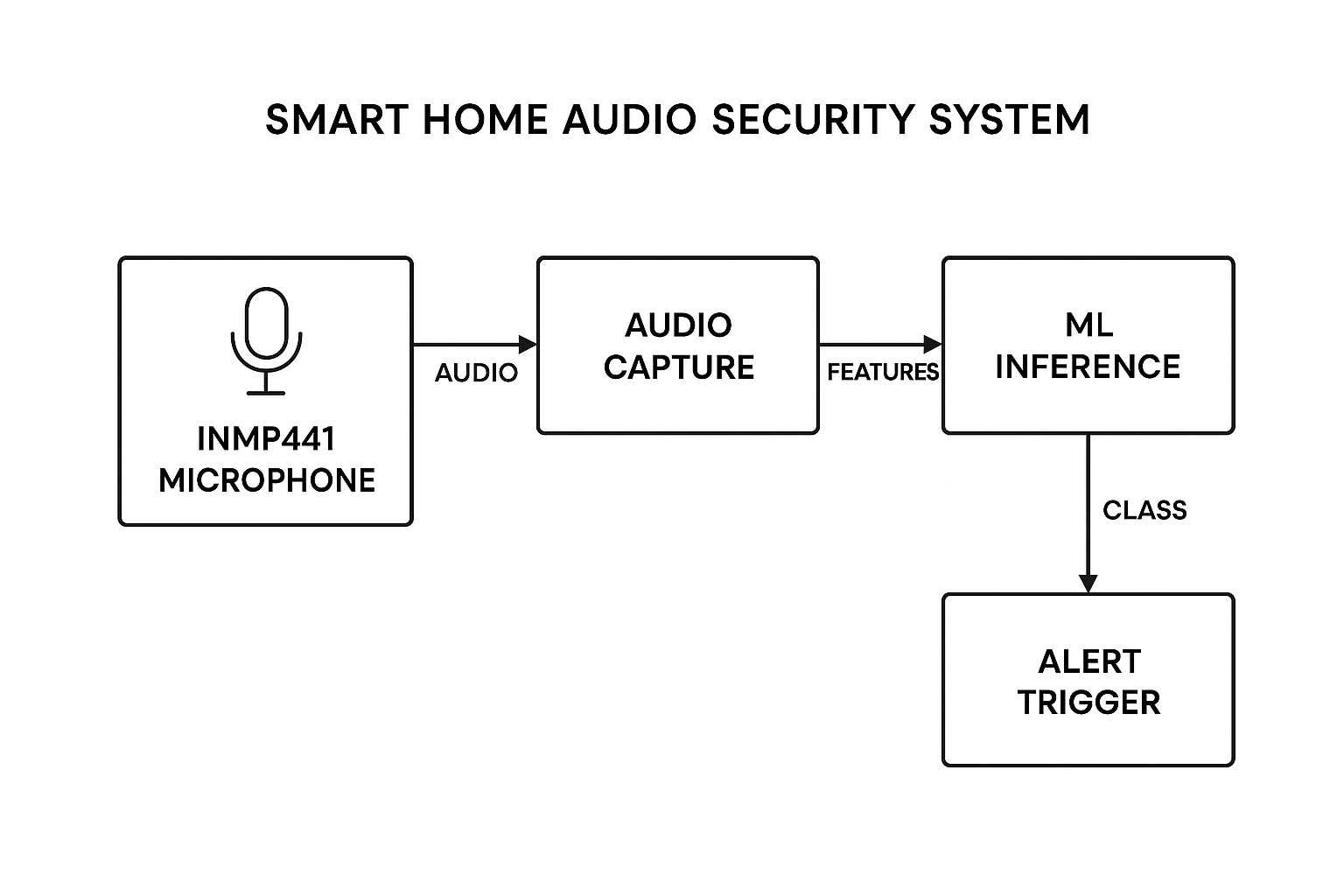
- Audio Capture: INMP441 continuously streams sound to the FRDM-i.MX93 via I²S.
- Preprocessing: Audio data is processed using FFT/MFCC extraction.
- Inference: ML model classifies sounds into categories — Familiar, Suspicious, or Emergency.
- Response: Based on detection, LEDs, buzzer, or network alerts are triggered.
- Local Operation: All analysis and decision-making occur on-device to maintain privacy
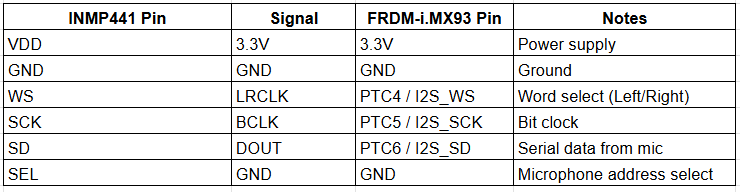
Pin Connection for INMP441 interfacing
System work flow Block Diagram
Features
- On-board ML inference using Ethos-U65 NPU
- Detects familiar voices and unusual sounds
- Real-time local audio event recognition
- Low-power edge operation
- Expandable for home automation integration
Future Scope
- Multi-room audio node integration
- Integration with camera for multi-sensor security
- Cloud analytics dashboard for sound history
- Continuous model improvement using on-device learning
Acknowledgments
Developed as part of the NXP i.MX93 Edge AI Design Challenge, demonstrating the power of embedded intelligence for smart home security applications.