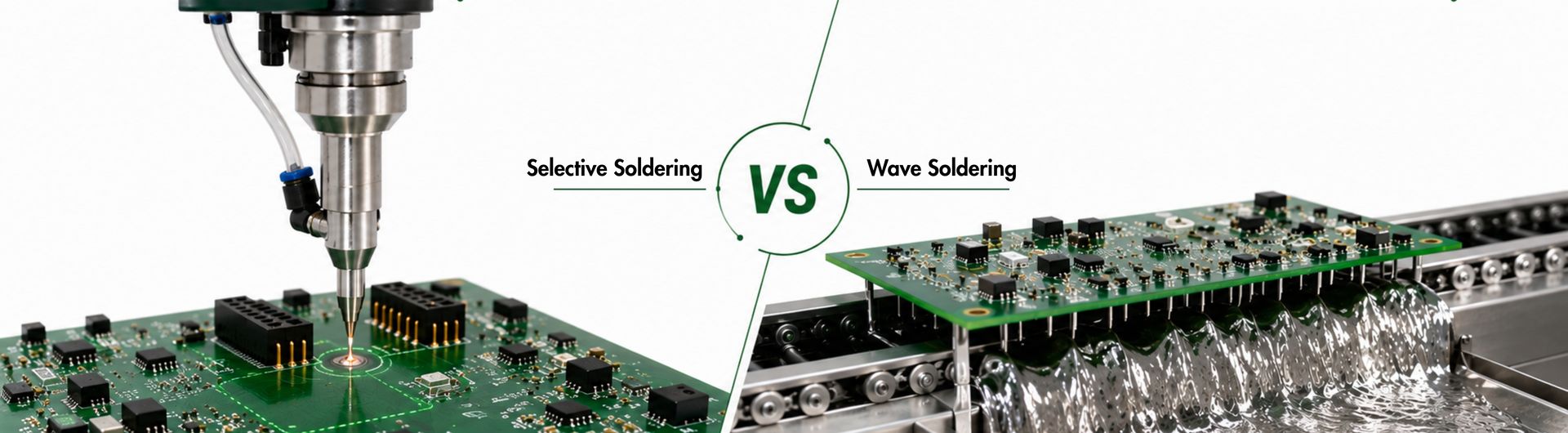
Both processes create durable solder joints, but they are designed for different PCB layouts and production requirements. While one offers high-speed production, the other delivers greater precision for complex assemblies.
If you're wondering which method is right for your project, this guide explains the differences, benefits, and ideal applications of both soldering techniques.
Understanding Selective Soldering
Selective soldering is a modern PCB assembly process that solders only the required through-hole components instead of exposing the entire board to molten solder.
Using a programmable mini-wave nozzle, solder is applied precisely where it's needed. This targeted approach minimizes heat exposure and protects nearby surface mount (SMT) components, making it an excellent choice for mixed-technology PCB assemblies.
Benefits of Selective Soldering
- High soldering precision
- Protects heat-sensitive SMT components
- Excellent for complex PCB layouts
- Minimal thermal stress
- Reduced need for masking or custom fixtures
- Consistent solder joint quality
Because of its flexibility, selective soldering is widely used for prototype builds, low-volume production, and high-density PCB designs.
What Is Wave Soldering?
Wave soldering has been a trusted manufacturing process for decades and remains one of the fastest ways to assemble through-hole PCBs.
In this process, the PCB passes over a controlled wave of molten solder, allowing every exposed through-hole joint to be soldered simultaneously.
Since multiple joints are completed in one pass, wave soldering is ideal for high-volume manufacturing where speed and consistency are priorities.
Advantages of Wave Soldering
- Fast production speed
- Ideal for large manufacturing volumes
- Consistent solder joints
- Cost-effective for standard PCB designs
- Excellent for boards containing mostly through-hole components
However, if a PCB contains many SMT parts, additional pallets or masking may be needed to prevent unwanted solder contact.
Selective Soldering vs. Wave Soldering
Both selective soldering and wave soldering are established processes for assembling through-hole components, but they differ in how solder is applied and the types of PCB assemblies they support. The right choice depends on factors such as PCB design, component mix, production volume, and production goals.
The table below highlights the key differences between the two processes.

Neither process is universally better than the other. Wave soldering offers high throughput efficiency for high-volume through-hole PCB assembly, while selective soldering provides greater precision for mixed-technology boards and assemblies containing heat-sensitive SMT components. Evaluating the PCB design and production goals early determine the most appropriate process for robust PCB assembly.
Factors to Consider Before Choosing a Soldering Process
Before selecting between selective soldering and wave soldering, engineers typically evaluate several important factors.
PCB Design
Complex layouts often benefit from selective soldering because it offers greater control around tightly packed components.
Component Mix
Boards containing both SMT and through-hole components usually require a more controlled soldering process.
Production Volume
Wave soldering becomes increasingly cost-effective as production volumes increase.
Thermal Sensitivity
Some electronic components can be damaged by prolonged heat exposure, making selective soldering the safer option.
Manufacturing Efficiency
The chosen process should balance production speed with assembly quality.
Required Reliability
Applications requiring consistent, high-quality solder joints often benefit from selecting the process that best matches the PCB design.

When Should You Choose Each Process?
The most suitable soldering process depends on the PCB design and production needs. The table below provides a quick comparison to help determine which process best fits your application.

Typical Applications for Through-Hole PCB Assembly
Even with the widespread adoption of SMT technology, through-hole PCB assembly remains essential for products that require strong mechanical connections and long-term reliability.
Common applications include:
- Industrial automation systems
- Power supplies
- Automotive electronics
- Medical devices
- Telecommunications equipment
- Aerospace and defense electronics
- Connectors, transformers, relays, and other large components
These applications demand dependable solder joints that can withstand vibration, electrical loads, and challenging operating environments.

Why Mixed-Technology PCB Assemblies Often Use Selective Soldering
Modern electronics frequently combine SMT and through-hole components on the same PCB.
In these situations, selective soldering provides a significant advantage because it heats only the required solder joints instead of exposing the entire board to molten solder.
Although wave soldering can still be used, manufacturers often need additional fixtures, pallets, or masking to protect SMT components during the process.
Selecting the appropriate soldering technique early in the design stage helps improve manufacturability while maintaining consistent assembly quality.
How PCB Power Supports Through-Hole PCB Assembly
At PCB Power, we provide both prototype and production PCB assembly services for through-hole and mixed-technology PCB assemblies.
Our team evaluates your PCB design, component mix, and manufacturing requirements to recommend the most suitable soldering process. Whether your project requires the precision of selective soldering or the speed of wave soldering, we focus on delivering reliable assembly quality for every build.
Final Thoughts
There isn't a single soldering process that works for every PCB. Selective soldering excels when precision, complex layouts, and mixed-technology assemblies are involved, while wave soldering remains the preferred choice for high-volume production with standard through-hole designs.
By understanding the strengths of each method, manufacturers can improve assembly quality, reduce production challenges, and build more reliable electronic products.
If you're planning your next through-hole PCB assembly project, working with an experienced manufacturing partner like PCB Power can help you choose the most effective soldering process for your application.
Know More: https://pcbpower.us/blog/pcb-assembly-10/selective-soldering-vs-wave-soldering-an-engineers-guide-45