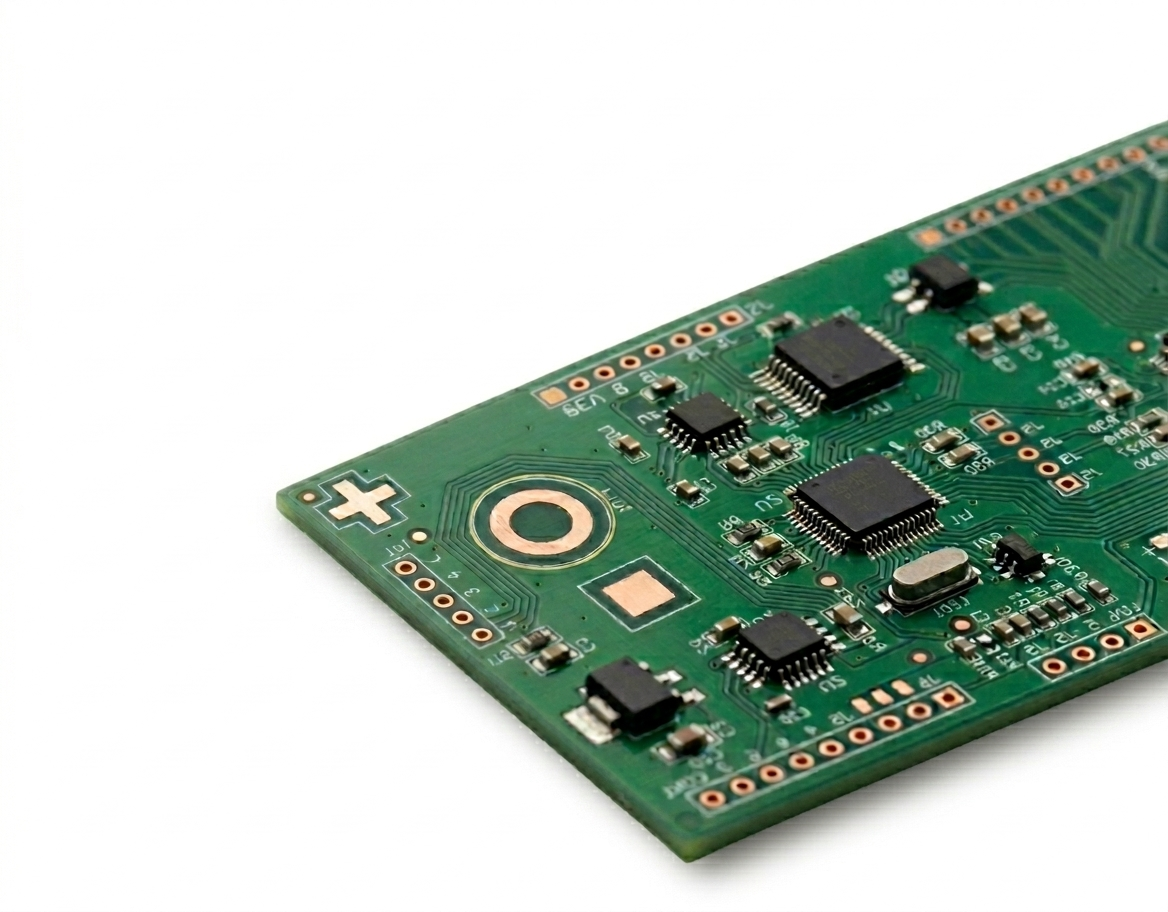
In comparison, fiducials are often treated as a minor detail during the early design stage.
However, once the board reaches manufacturing, the importance of Fiducials in PCB Assembly becomes much clearer. These small reference marks help automated assembly machines identify the exact position of the board before component placement begins. While they may appear insignificant on the surface, fiducials play a major role in placement precision, manufacturing consistency, and assembly reliability.
As PCB designs continue becoming smaller and more complex, accurate positioning is no longer optional. Even a slight alignment issue during assembly can affect solder quality, placement accuracy, and final product reliability. That is why fiducials are considered an essential part of modern PCB manufacturing and assembly processes.
Understanding the Role of Fiducials in PCB Assembly
In automated PCB production, pick-and-place machines are responsible for placing components onto the board at high speed and with high precision. These systems do not simply rely on digital design files alone. Before placement begins, the machine must confirm the actual physical position of the board inside the assembly equipment.
Real-world manufacturing conditions are rarely perfect. During handling and transportation, a PCB panel can shift slightly. Small fabrication tolerances can also create minor positional variations. Even a minimal rotation or offset can affect placement accuracy, especially on dense boards with compact layouts.
This is where Fiducials in PCB Assembly become important. Fiducials act as visual reference points that allow the machine vision system to detect the board’s exact orientation and location. Once these marks are identified, the machine adjusts its positioning before placing components.
Without fiducials, the assembly system has less confidence in board alignment. On modern high-density boards, reduced alignment accuracy increases the possibility of placement errors, soldering problems, and production inconsistencies.
Why Fiducials Matter More on High-Density PCB Designs
PCB designs are evolving rapidly. Products are becoming smaller, faster, and more compact, which means boards now contain tighter layouts and finer-pitch components than ever before. This leaves very little room for alignment mistakes during assembly.
On simpler boards with larger spacing between components, a small positional offset may not immediately create a serious issue. But dense PCB layouts are far less forgiving. Fine-pitch ICs, compact connectors, and miniature surface-mount components require extremely accurate placement.
Because of this, Fiducials in PCB Assembly play an even more critical role in modern electronics manufacturing. These reference marks help machines maintain accurate alignment throughout the placement process and reduce the likelihood of defects caused by positional errors.
Without proper fiducials, manufacturers may encounter issues such as:
- Incorrect component placement
- Solder bridging and solder defects
- Inspection and testing complications
- Increased rework requirements
- Production delays and reduced consistency
These problems can impact both manufacturing efficiency and final product reliability. That is why experienced PCB assembly providers strongly recommend proper fiducial placement during the design phase.
How Fiducials Improve PCB Assembly Efficiency
Most discussions around Fiducials in PCB Assembly focus on placement accuracy, but their value extends beyond precision alone. Fiducials also contribute to smoother and more efficient production flow.
When assembly machines can quickly identify the board and verify alignment, setup becomes faster and more reliable. Operators spend less time making manual corrections or troubleshooting alignment problems. This helps reduce interruptions during the production run and allows the process to move more efficiently from one manufacturing stage to the next.
Improved alignment also supports better production consistency. Consistency is especially important for companies producing larger PCB volumes or working with complex assemblies where repeatability matters.
Reliable fiducials can help manufacturers achieve:
- Faster machine setup
- Reduced assembly interruptions
- Better placement consistency
- Lower rework rates
- Improved inspection accuracy
- More dependable production output
For businesses looking for dependable PCB manufacturing and assembly services, these operational advantages can directly support product quality and turnaround expectations.
Fiducials Support Better Inspection and Quality Control
Another important advantage of Fiducials in PCB Assembly is their contribution to inspection accuracy. Modern PCB production relies heavily on automated optical inspection systems to verify component placement and solder quality after assembly.
Inspection equipment also uses fiducials as alignment references when scanning the board. Accurate reference points help the system compare the assembled board against the intended design and identify defects more effectively.
Without reliable fiducials, inspection systems may struggle to verify alignment properly, especially on compact boards with tight spacing. This can increase the chances of missed defects or false inspection errors.
By supporting both placement accuracy and inspection reliability, fiducials help strengthen the overall quality control process throughout PCB production.
Conclusion
Fiducials may be small design features, but their role in manufacturing is extremely important. They help automated machines determine the board’s exact position before placement begins, ensuring components are aligned correctly during assembly.
As PCB designs continue becoming denser and more complex, the importance of Fiducials in PCB Assembly continues to grow. These simple reference marks help reduce alignment errors, improve manufacturing consistency, support inspection accuracy, and minimize avoidable production issues.
While fiducials may not receive much attention during early design discussions, they become one of the most valuable elements once the board reaches the assembly line. Proper fiducial planning supports smoother production, better reliability, and more dependable PCB assembly outcomes.
If your PCB design is moving toward manufacturing, working with an experienced PCB assembly partner can help ensure your board is properly prepared for efficient production and consistent assembly performance.
Know More : https://www.pcbpower.us/blog/role-of-fiducials-in-pcb-board-assembly