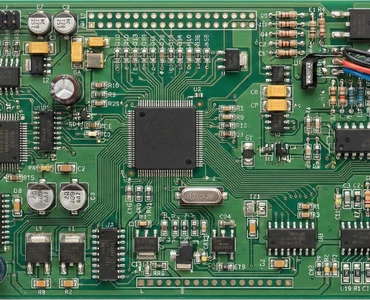
This guide explains what a Printed Circuit Board is, why it is essential, and how modern trends are reshaping its role in advanced electronics.
What is a Printed Circuit Board?
A Printed Circuit Board (PCB) is a flat board that mechanically supports and electrically connects electronic components using conductive pathways etched from copper sheets laminated onto a non-conductive substrate.
In modern electronics, a Printed Circuit Board acts as the backbone of the system—ensuring stable electrical connections, signal flow, and component integration.
Why Printed Circuit Boards Are Essential in 2026
1. Foundation of All Electronic Systems
Every electronic product depends on a Printed Circuit Board to operate efficiently. Without it, components cannot communicate or function cohesively.
Insight: As devices become more compact, the importance of optimized PCB design and integration continues to grow.
2. Enables Miniaturization & High Performance
Modern devices demand:
- Smaller footprints
- Higher processing speeds
- Greater functionality
A well-designed Printed Circuit Board allows engineers to integrate multiple components into a compact space without compromising performance.
Trend: Over 70% of new electronic products now rely on multi-layer PCB architectures to meet performance requirements.
3. Improves Reliability & Durability
Compared to traditional wiring, a Printed Circuit Board offers:
- Strong mechanical support
- Reduced connection failures
- Consistent electrical performance
This is especially critical in sectors like automotive, healthcare, and aerospace.
4. Supports Scalable Manufacturing
For mass production, consistency is key. Printed Circuit Board Manufacturers enable standardized production processes, ensuring uniform quality across batches.
Industry Benchmark:
Automated PCB production lines can achieve significant defect reduction when combined with proper design validation and assembly practices.
Role of Printed Circuit Board Manufacturers in 2026
Driving Innovation in Electronics
Modern Printed Circuit Board Manufacturers are not just fabricators—they are technology partners contributing to:
- High-density interconnect (HDI) designs
- Flexible and rigid-flex PCBs
- Advanced material usage
Ensuring Quality & Compliance
Manufacturers play a key role in:
- Material selection
- Process control
- Quality assurance
Expert Insight:
“The reliability of an electronic product is directly tied to the quality standards followed by its PCB manufacturing process.”
Importance of Printed Circuit Board Assembly Service
Bridging Design and Functionality
A Printed Circuit Board Assembly Service transforms a bare board into a functional electronic system by placing and soldering components accurately.
Key Advantages of Professional Assembly
- Precision placement of components
- Reduced human error through automation
- Faster production cycles
- Consistent quality across units
Trend Insight:
In 2026, over 65% of electronics companies rely on specialized Printed Circuit Board Assembly Service providers to improve efficiency and scalability.
Types of Printed Circuit Boards in Modern Applications
Single-Layer PCB
Used in simple electronics with minimal complexity.
Multi-Layer PCB
Common in advanced devices requiring high performance and compact design.
Flexible PCB
Designed for applications where space and flexibility are critical.
Rigid-Flex PCB
Combines durability with flexibility, widely used in aerospace and medical devices.
Common Challenges in PCB Development
Increasing Design Complexity
As circuits become more advanced, designing an efficient Printed Circuit Board requires specialized expertise.
Signal Integrity & Thermal Management
High-speed devices require careful planning to avoid signal loss and overheating.
Manufacturing Constraints
Designs must align with manufacturing capabilities to avoid delays and defects.
For deeper insights into why PCBs are critical, refer to:
https://www.pcbpower.com/blog-detail/why-is-a-printed-circuit-board-necessary
Actionable Takeaways for Businesses
1. Prioritize Design for Manufacturing (DFM)
Ensure your Printed Circuit Board design aligns with production capabilities from the start.
2. Choose Reliable Manufacturing Partners
Collaborate with experienced Printed Circuit Board Manufacturers to ensure consistent quality and performance.
3. Leverage Professional Assembly Services
Using a trusted Printed Circuit Board Assembly Service improves accuracy, reduces errors, and accelerates production timelines.
4. Invest in Quality Over Short-Term Gains
Reliable PCB design and assembly directly impact product performance and longevity.
Explore more insights here:
https://www.pcbpower.com/blog-detail/why-is-a-printed-circuit-board-necessary
Expert Takeaways for 2026
- The Printed Circuit Board is the backbone of all modern electronics
- Advanced designs require collaboration between designers, manufacturers, and assembly providers
- Automation and AI are reshaping PCB manufacturing and assembly processes
- Quality and reliability are becoming key differentiators in competitive markets
Final Thought
In 2026, the importance of the Printed Circuit Board extends far beyond connectivity—it defines the performance, reliability, and scalability of electronic products.
Businesses that invest in strong design practices, partner with experienced Printed Circuit Board Manufacturers, and utilize efficient Printed Circuit Board Assembly Service solutions will be better positioned to innovate and succeed in an increasingly competitive electronics landscape.