A simple, budget-friendly guide to building your own wireless Bluetooth speaker — learn electronics basics and enjoy clear, portable sound for under ₹500.
🎧 Make Your Own Wireless Speaker — The Maker Way
If you’ve ever wanted to build a project that’s affordable, beginner-friendly, and genuinely useful, a DIY Bluetooth speaker amplifier is the perfect choice. It combines hands-on electronics, audio principles, and creative design — all while giving you a device you’ll actually use every day. With just a few inexpensive components, you can craft a compact wireless speaker that pairs instantly with your phone and sounds surprisingly good for its size.
This project is ideal for students, hobbyists, tinkerers, STEM creators, and anyone who loves the satisfaction of building something functional with their own hands.
🔩 What You’ll Need (And Why)
The heart of this project is incredibly simple. You only need a handful of modules:
- Bluetooth Audio Module
- This handles wireless connectivity. Modules like JDY-62 or similar receive audio from your smartphone via Bluetooth and output left and right channel signals.
- Stereo Amplifier Board (e.g., PAM8403)
- The amplifier boosts the audio signals so they can drive your speakers effectively. Even a small 3-watt PAM8403 board delivers crisp, clear sound for tiny setups.
- Speakers (2W–3W, 4Ω–8Ω)
- Compact drivers work perfectly for small portable enclosures.
- 5V Power Source
- You can use a USB adapter, power bank, or integrate a rechargeable battery later.
- Wire + Soldering Tools
- Basic wiring skills are all you need — this is a fantastic beginner soldering project.
- Optional (but awesome)
- Wooden/3D-printed enclosure
- Rechargeable Li-ion battery + charging board
- Power switch
- Volume knob
- LED indicators
These optional add-ons help you level up from “simple speaker” to “custom masterpiece.”
🧠 How It Works (The Simple Circuit Behind the Build)
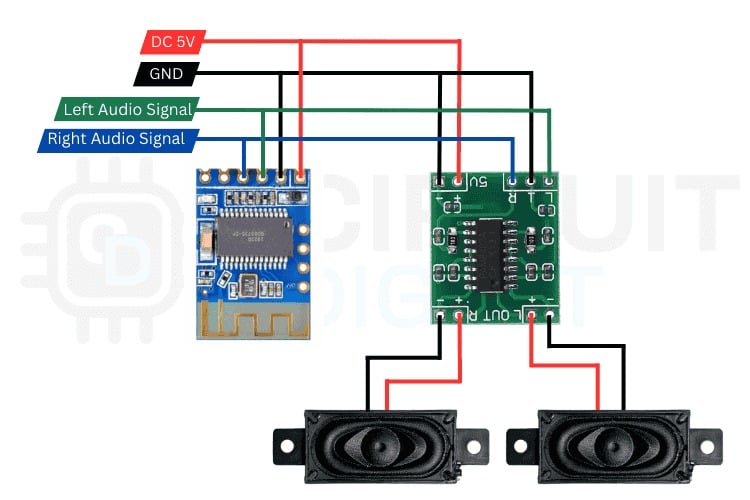
The wiring is clean and straightforward:
- Bluetooth Module → Amplifier
- The Bluetooth module sends L/R audio directly to the amplifier input pins.
- Amplifier → Speakers
- The amplifier boosts the signal and sends it to the left and right speaker drivers.
- Power
- Both modules run off the same 5V supply. This makes the circuit easy to power from USB or a battery pack.
- Enclosure
- The enclosure you use — wooden box, 3D-printed shell, acrylic case — shapes the final sound and aesthetic. A good enclosure enhances bass, reduces rattling, and gives a professional finish.
That’s it. No microcontroller, no programming, no complicated schematics. It’s pure analog bliss.
🛠 Step-By-Step Build Overview
1. Prepare Your Components
Lay out the Bluetooth module, amplifier board, speaker units, wires, and power source. Double-check the modules’ pinouts.
2. Connect the Bluetooth Audio Outputs
Solder the left, right, and ground outputs from the Bluetooth module to the amplifier board’s input pins. Keep wires short to minimize noise.
3. Wire the Speakers to the Amplifier
Attach your speaker leads to the amplifier’s output terminals. Ensure polarity is correct to maintain stereo integrity.
4. Power Everything Up
Connect the amplifier and Bluetooth module to your 5V source. A USB power bank makes testing very convenient.
5. Test the Setup
Turn on your phone’s Bluetooth, connect to the module, and play some audio. If everything’s wired correctly, you’ll hear clean output from both speakers.
6. Build or Assemble Your Enclosure
Place the electronics inside your housing. Add foam padding to prevent vibration, drill sound ports, and secure speakers with screws or glue.
7. Final Touches
Add switches, LEDs, or a charging port if you're going truly portable.
🚀 Why Makers Love This Project
✔ Hands-On Learning
You learn soldering, wiring, audio paths, module integration, and enclosure design — all in a single afternoon.
✔ Affordable & Accessible
Most parts cost very little, and you can salvage speakers or enclosures from old devices.
✔ Highly Customizable
Switch amps, add bigger speakers, make a wooden cabinet, or build a multicoloured LED sound-reactive front panel — the project grows with your skills.
✔ Real-World Usefulness
This isn’t just a showcase project. It becomes a daily-use device you’ll be proud to say you made.
🌟 Upgrade Ideas for Advanced Makers
Once you build the basic version, try levelling up:
- Add a Li-ion battery + TP4056 charging board for full portability.
- Use a higher-wattage amplifier for louder, fuller audio.
- 3D-print a tuned bass enclosure for richer low-end performance.
- Add a rotary potentiometer for volume control.
- Incorporate status LEDs for charging, battery level, or Bluetooth pairing.
These enhancements help transform your DIY Bluetooth speaker into something that rivals commercial products.