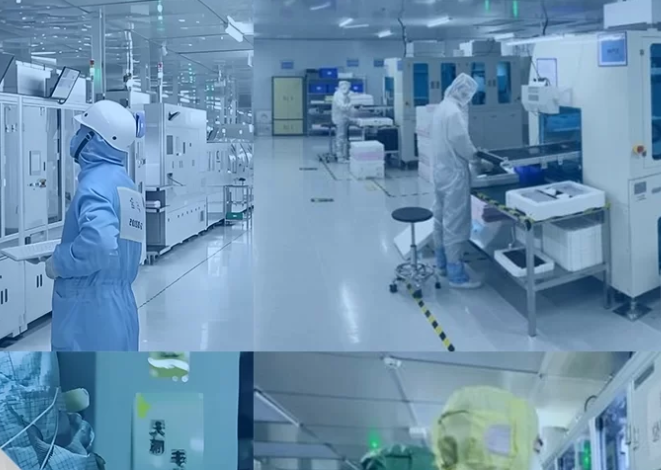
OLED, or Organic Light Emitting Diode, panels are rapidly changing the landscape of display technology across various industries, and electronics manufacturing is no exception. Miqidisplay, as a provider of these advanced display solutions, is seeing increased adoption of its OLED panels in this sector. But why are these panels gaining so much traction? The answer lies in a combination of factors: superior visual performance, design flexibility, and enhanced operational efficiency.
One of the primary reasons for the shift towards OLED panels is their unparalleled image quality. Unlike traditional LCDs that require a backlight, OLEDs are self-emissive. Each pixel generates its own light, resulting in true blacks, infinite contrast ratios, and vibrant colors. This is particularly crucial in electronics manufacturing, where precision and clarity are paramount. Imagine a technician inspecting a complex circuit board under a microscope; a Miqidisplay OLED panel would provide a much clearer and more detailed view than a conventional display, reducing eye strain and improving accuracy.
The superior contrast ratio is a game-changer. In quality control, for example, defects are often subtle variations in color or brightness. With an OLED panel, these variations become far more noticeable, allowing for faster and more reliable detection. This translates directly into higher product quality and reduced waste.
Design flexibility is another key advantage. OLED panels can be manufactured on flexible substrates, enabling curved, foldable, and transparent displays. This opens up a world of possibilities for innovative product designs and human-machine interfaces (HMIs) in electronics manufacturing equipment. Picture a control panel that seamlessly integrates into the curved surface of a machine, providing operators with a more ergonomic and intuitive experience. Or, consider a transparent OLED display overlaid on a piece of equipment, providing real-time data and instructions without obstructing the view of the underlying components.
Furthermore, Miqidisplay's OLED panels are known for their thin and lightweight design. This is particularly beneficial in portable devices and handheld instruments used in electronics manufacturing. A lighter device is easier to handle and reduces operator fatigue, leading to increased productivity.
Another significant factor driving the adoption of OLEDs is their energy efficiency. While older OLED technologies sometimes struggled with power consumption, advancements in materials and manufacturing processes have significantly improved their efficiency. In many applications, OLEDs now consume less power than comparable LCDs, especially when displaying content with dark backgrounds. This can lead to lower operating costs and a reduced environmental footprint for electronics manufacturers.
Durability is also a key consideration. Electronics manufacturing environments can be harsh, with exposure to dust, chemicals, and extreme temperatures. Miqidisplay's OLED panels are designed to withstand these conditions, ensuring reliable performance and a long lifespan. This reduces the need for frequent replacements, minimizing downtime and maintenance costs.
Beyond the technical advantages, there's also a growing demand for visually appealing and user-friendly interfaces in electronics manufacturing equipment. Operators are more productive and engaged when they're working with equipment that is both functional and aesthetically pleasing. Miqidisplay's OLED panels can help manufacturers create equipment that stands out from the competition and attracts top talent.
Consider the application of OLED panels in testing and measurement equipment. High-resolution, high-contrast displays are essential for visualizing complex data and waveforms. Miqidisplay's OLED panels provide the clarity and accuracy needed to interpret this data effectively, enabling engineers to identify and resolve issues more quickly.
In automated assembly lines, OLED panels can be used to display real-time production data, machine status, and error messages. This information can be easily viewed from a distance, allowing operators to monitor the line's performance and respond quickly to any problems. The vibrant colors and sharp contrast of the OLED display make it easy to distinguish between different types of information, even in a busy manufacturing environment.
The integration of touch functionality with OLED panels further enhances their usability. Touchscreen interfaces are becoming increasingly common in electronics manufacturing equipment, allowing operators to interact with the equipment more intuitively. Miqidisplay offers OLED panels with integrated touch sensors, providing a seamless and responsive user experience.
The supply chain for OLED panels is also becoming more mature and reliable. Miqidisplay has established strong relationships with its suppliers, ensuring a consistent supply of high-quality materials. This gives electronics manufacturers confidence that they can rely on Miqidisplay to meet their display needs.
Of course, there are still some challenges to overcome. OLED panels can be more expensive than traditional LCDs, although the price gap is narrowing. However, the benefits of OLED technology, such as improved image quality, design flexibility, and energy efficiency, often outweigh the higher upfront cost.
Another challenge is the potential for burn-in, which can occur when static images are displayed for extended periods of time. However, Miqidisplay has implemented various techniques to mitigate this issue, such as pixel shifting and automatic brightness adjustment.
Looking ahead, the adoption of OLED panels in electronics manufacturing is expected to continue to grow. As the technology matures and prices continue to fall, OLEDs will become an increasingly attractive alternative to LCDs. Miqidisplay is committed to staying at the forefront of OLED technology, developing innovative solutions that meet the evolving needs of the electronics manufacturing industry.
The future holds exciting possibilities for OLED displays in this sector. We can expect to see more curved and flexible displays, transparent displays, and displays with integrated sensors. Miqidisplay's OLED Panels will enable manufacturers to create more innovative and user-friendly equipment, ultimately leading to increased productivity and improved product quality.
The initial investment in OLED technology might seem daunting to some, but the long-term benefits are undeniable. Improved accuracy, reduced eye strain, enhanced design possibilities, and increased energy efficiency all contribute to a more streamlined and cost-effective manufacturing process.
Miqidisplay understands the unique demands of the electronics manufacturing industry and is dedicated to providing OLED solutions that meet those needs. From small, high-resolution displays for handheld instruments to large, interactive displays for control panels, Miqidisplay offers a wide range of OLED panels to suit various applications. They are not just selling displays; they are providing solutions to enhance manufacturing processes.
In conclusion, Miqidisplay's OLED panels are rapidly gaining traction in the electronics manufacturing industry due to their superior visual performance, design flexibility, energy efficiency, and durability. While challenges remain, the benefits of OLED technology are becoming increasingly clear, making it a compelling choice for manufacturers looking to improve their operations and create more innovative products. The move toward OLED is not just a trend; it's a strategic investment in the future of electronics manufacturing.