EcoSort Edge is a retrofit lid that turns any 47–58 cm trash can into an AI sorter for plastic, metal, and trash. A PHYTEC phyBOARD-RT1170 (NXP i.MX RT1170) runs an int8 vision model in 14 ms and drives the lid servos. Its sloped chute design uses 41.8% less height than seesaw bins, and it's ready 5 s after power-on.
The problem
Recycling contamination costs U.S. recovery facilities at least $300 million a year, and one wrong item can get an entire batch rejected and sent to landfill. Automated sorting bins exist, but they cost thousands of dollars, and most use a tilting seesaw plate that needs empty space above and below it, which eats into the can's capacity.
What EcoSort Edge does
EcoSort Edge is a retrofit lid that turns any existing 47–58 cm trash can into an automatic three-way sorter for plastic/paper, metal, and trash. It started as a Raspberry Pi prototype for our county science fair. For this contest we replaced the Pi with a PHYTEC phyBOARD-RT1170 and rewrote the software on Zephyr RTOS, keeping the same 3D-printed lid.
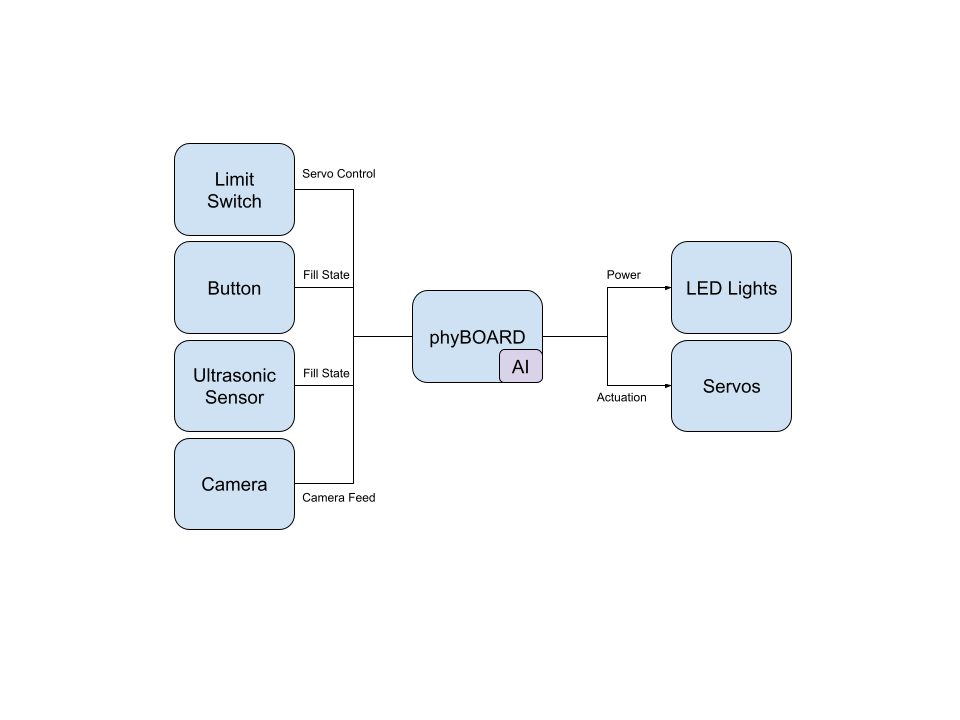
Figure 1. System architecture. The limit switch, reset button, ultrasonic fill sensor, and camera feed inputs into the phyBOARD-RT1170, which runs the AI model and drives the LED lights and servos.
How it works: electronics
A Pcam 5C camera on the board's MIPI-CSI port watches the chute. A lightweight motion detector runs continuously, and the classifier only runs when an item appears. At that point a white LED lights the item and an int8-quantized MobileNetV2, running on TensorFlow Lite Micro with CMSIS-NN, classifies it on the Cortex-M7.
The Cortex-M4 handles everything that moves: the lid and chute servos, the homing limit switch, and the HC-SR04 fill sensor. The two cores talk over an RPMsg mailbox, so inference never delays a servo stop. A green LED blinks once, twice, or three times to show the sort result, and a red LED locks the lid when a compartment is full until someone presses reset.
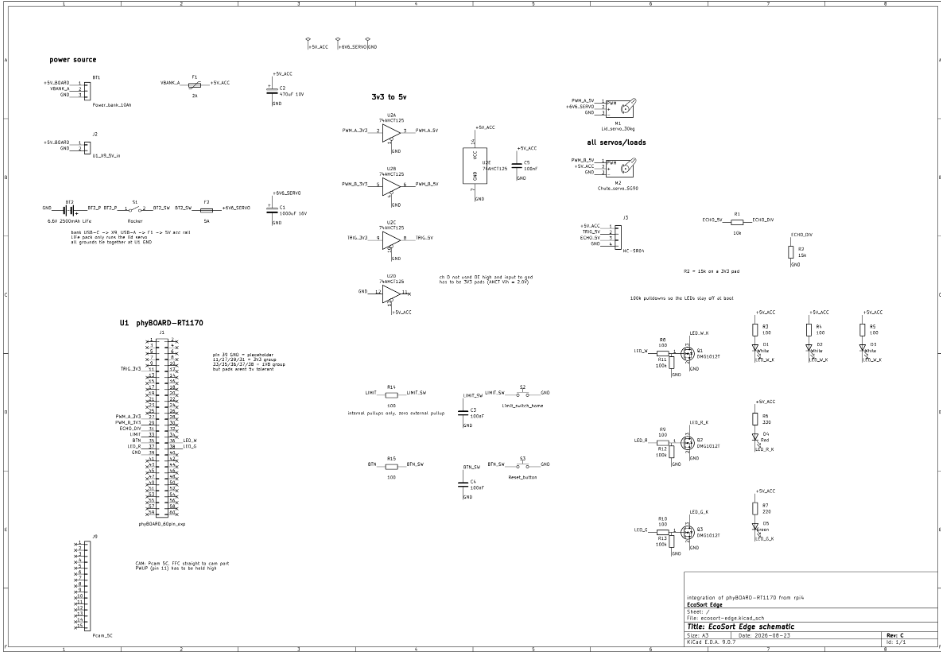
The RT1170's header has 3.3V and 1.8V pins, and none of them are 5V tolerant. A 74AHCT125 buffer lifts the servo and trigger signals to 5V, a resistor divider brings the sensor echo down, and low-threshold MOSFETs switch the LEDs from 1.8V pins. A power bank runs the board and accessories, and a separate 6.6V LiFe pack runs the high-torque lid servo, with both sharing one ground.
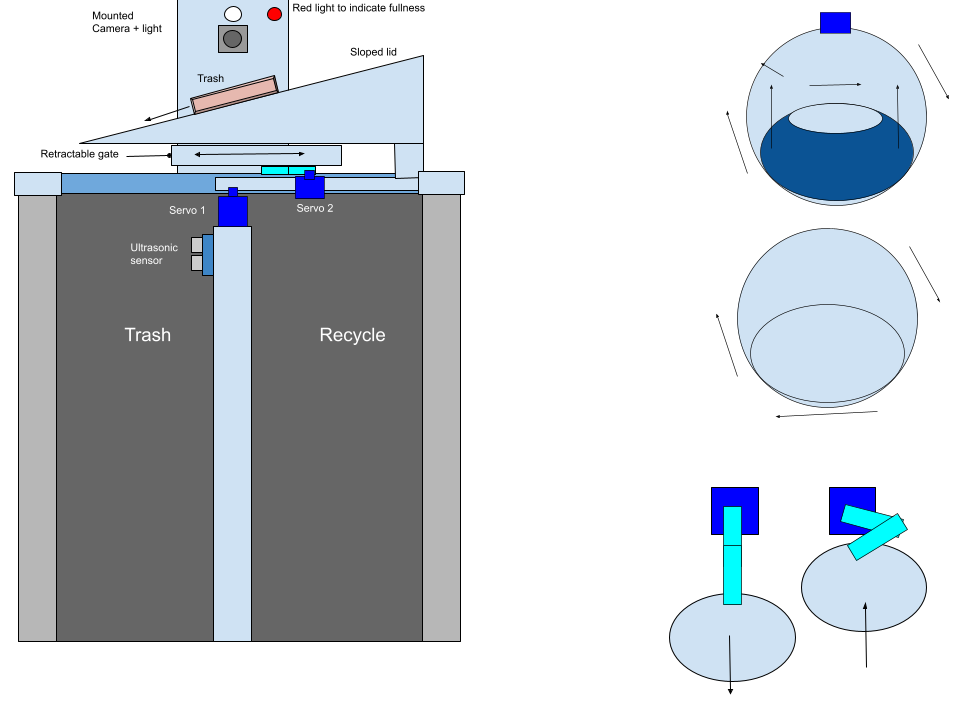
Figure 2. Early mechanical concept. Items slide down the sloped lid to a servo-driven retractable gate and drop into the compartment below. The rotation views on the right show how the lid turns to line up with each compartment.
How it works: Mechanics
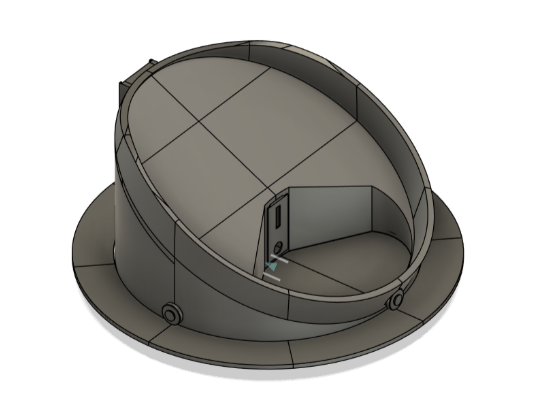
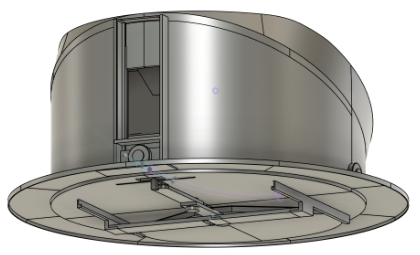
Instead of a seesaw, items slide down a sloped lid to a chute at the bottom. The lid rotates to line up with the right compartment, then a micro servo opens the chute gate. The final build is 27.35 cm tall, compared with 47 cm for an equivalent seesaw, so it uses 41.8% less height inside the can.
Results
The lid is ready 5 s after power-on and classifies an item in 14 ms. In earlier testing, retraining with more data raised accuracy from 70.8% to 79.2%, and the white LED raised dark-room accuracy from 6/9 to 9/9 items. The build costs about $354 at list price, with the dev kit making up most of that, compared with thousands of dollars for commercial bins. We cut the planned MIPI-DSI screen to save cost and used LEDs for feedback instead.
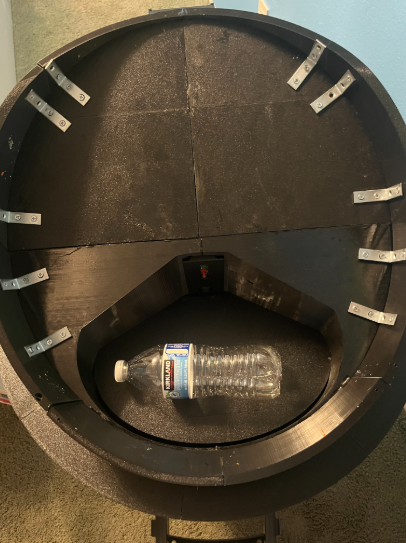
Figure 3. Sort test, top view. A plastic bottle rests on the chute gate at the bottom of the sloped lid while the camera, mounted in the back wall, captures it for classification. The metal braces around the rim reinforce epoxied joints that came apart during earlier testing.
What's next
We plan to demo the lid at local libraries and pilot it on school recycling cans and within public spaces to get real-world feedback.
Acknowledgements
We're grateful to PHYTEC and NXP for providing the phyBOARD-RT1170 Development Kit, and to All About Circuits and EETech for running this contest. Getting to work with an industrial dual-core board, Zephyr, and on-device machine learning took our science fair prototype much further than we could have on our own, and taught us more about embedded systems than any class has. Thank you as well to our computer science teacher, Mr. David, who advised the original project, and to our parents for their support.
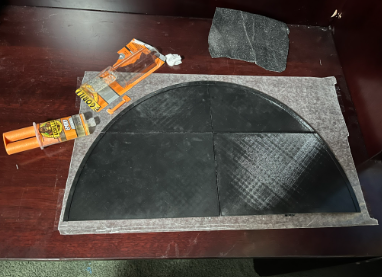
Figure 4. Assembling the lid. The sloped lid was too large for our printer bed, so we printed it in four PETG sections and joined them with two-part structural epoxy. We sanded each mating edge first, because our first unsanded joint failed almost immediately.
Figure 5. Full schematic (KiCad, Rev C). Power comes from a 10,000 mAh power bank for the phyBOARD-RT1170 and a fused 5 V accessory rail, plus a separate fused 6.6 V LiFe pack for the 30 kg lid servo, all on one common ground. A 74AHCT125 buffer lifts the 3.3 V servo and trigger signals to 5 V, and a resistor divider drops the HC-SR04 echo back to the pad's voltage. DMG1012T MOSFETs switch the white, red, and green LEDs from 1.8 V pins. The limit switch and reset button use the pins' internal pull-ups with RC debounce, and the Pcam 5C connects directly to the camera port.